
Josephine Burton and Anastasiia Kosodii
UK Theatre Director and playwright Josephine Burton and Ukrainian playwright Anastasiia Kosodii premiered Dash Arts’ new play, The Reckoning, in Summer 2025. The Reckoning is a work of documentary theatre, rooted in the testimonies of survivors of the current war in Ukraine. The two writers discussed their process and explored some of the ethical challenges behind depicting the conflict on stage.
Josephine Burton: It’s very nice to be with Anastasiia Kosodii this morning. I’m Josephine Burton, and I am sitting in a hotel room in Tallinn, Estonia. Where are you, Anastasiia?
Anastasiia Kosodii: I’m in Berlin.
JB: We are thrilled to be able to talk a little bit about our process and, the priorities that have driven our writing of a new piece of theatre, The Reckoning, which Anastasiia and I have been working on for the last year. We’re excited to discuss it in the context of the Interventions section in the Contemporary Theatre Review.
Anastasiia, Can you cast your mind back to, I guess, Spring 23, when I approached you and said I had been given access to this archive of testimonies from the Reckoning Project and the Public Interest Journalism Lab (PIJL) in Ukraine. Can you remember when you, casting on mine back to that time, can you remember, like how? What did you think when I asked you if you’d be interested in making a piece of theatre with me, and what interested you about doing it?
AK: Yeah, right, I think. Well, I mean, I had 2 thoughts at that moment. On one hand, I was super excited because it’s very rare that a playwright comes across such a big, you know, archive of information that’s been pre-recorded, transcribed. It was a piece of very valuable information because usually I would call people and record them myself, and then it’s a much, much slower process for me. On the other hand, I mean, I was also excited because I knew your work was Songs of Babyn Yar, and I liked it very much, and I said, well I’m very glad. I was a bit concerned because I saw the topics also introduced, and I saw that they were the biggest sort of war crimes that they’ve had since the start of the Russian invasion of Ukraine and I was like, Okay, so this is rather, you know, an unnatural order of things because when you go yourself to record this type of testimonies and it still takes time for you to do them but when you just have a whole archive it can be a bit overwhelming.
I remember also there was this talk between us and a psychologist to figure out how to work with material.
How was it for you? Because you came to this project much earlier? How did it start for you?
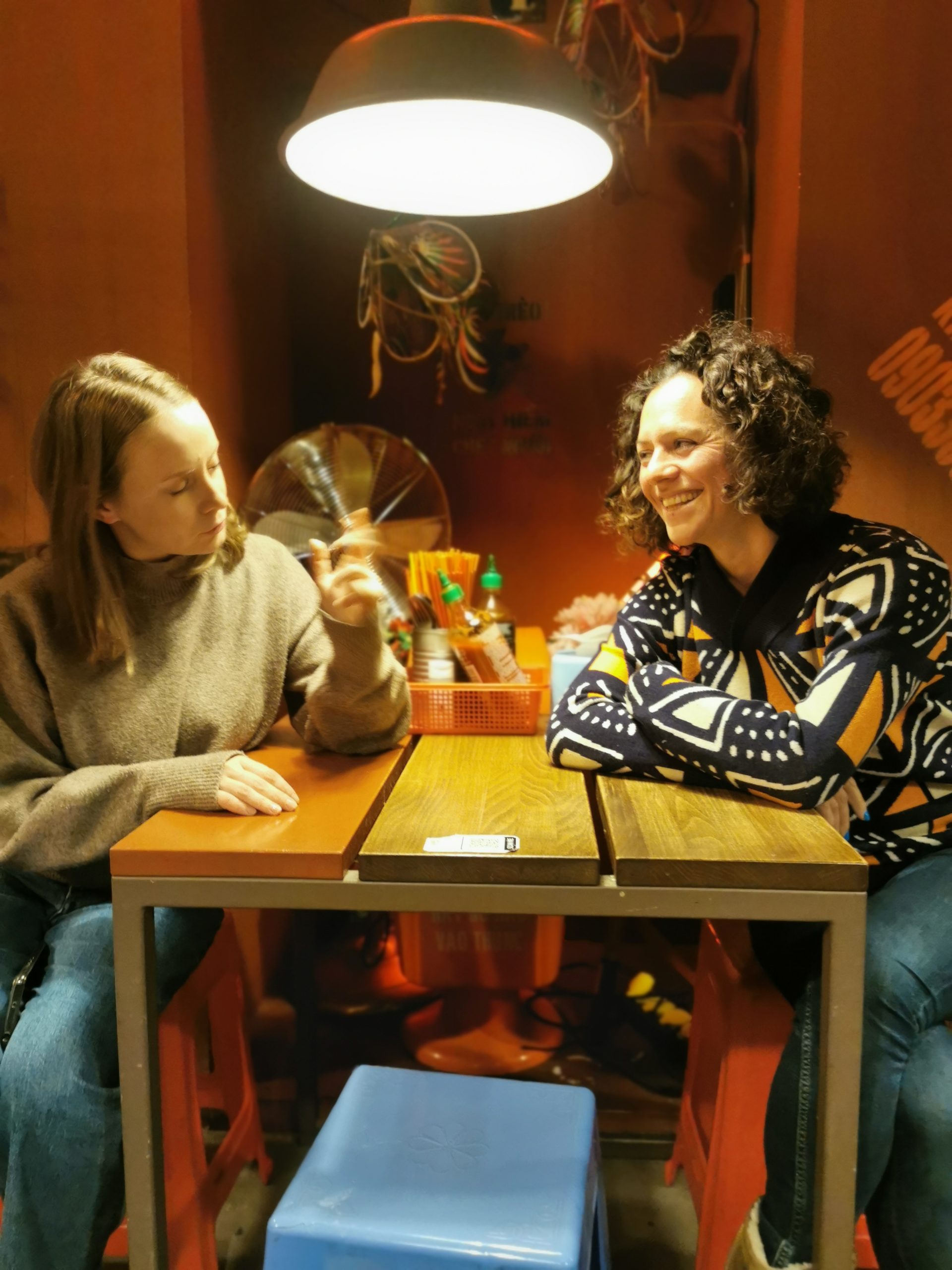
Writers Josephine Burton and Anastasiia Kosodii during Research and Development in Berlin (2023). Photo by Yuriy Gurzhy
JB: Thank you, Nastiia. I want to, actually, ask you a little bit more about the overwhelmingness in a moment because I think that’s a very interesting reflection.
I had been approached a couple of months earlier by the team who are running the archive, and they felt very strongly that they were gathering these testimonies in order to prosecute the Russians in the courts of law, and part of what was driving them was also to ensure that these testimonies are heard in what they consider to be the court of public opinion, out there in the world. So, they turned to me because they know that I make theatre and have the potential to explore these testimonies in a different forum that could bring awareness to the work. At the same time, I was working on your text, Crimea 5am, Anastasiia, and thinking about how to stage it in London as part of the UK Ukraine season of culture. I really enjoyed the conversations that we had, and we had the opportunity to meet and talk a little bit about your text and your intentions behind the text. And I just found, I really enjoyed the conversation and your writing with Crimea 5am. So it was that combination of admiring your work and feeling like we had the potential to get on. You know, you just have those instincts, and my instinct at that moment was that I could never possibly work on this text without a Ukrainian, and you were the obvious person to work with.
I took on the challenge. I wanted to take on the responsibility of thinking about how to stage the texts. But I knew that I had to do that in tandem with a Ukrainian writer.
I couldn’t be a Brit, tackling this material on my own.
And like you, I also felt quite overwhelmed by the entire, you know, just the enormity of that archive. We were given great aid by the team in Ukraine from the PIJL. They were brilliant …they said ‘Well if you wanted to have a cross-section of the testimonies, there are different kinds of themes. There are themes of shelling, there are themes of experiences of evacuations, of being held hostage.’ He outlined the different areas and then sent us a selection of the testimony. We read, probably 30, 40 ouf of the more than 300 they have conducted.
AK: There were a lot of them on that paper. I remember, I think in August, like the whole of August we were reading all of them. I had a schedule for myself to read at least 3 in a day.
JB: Had you looked at testimonies coming out of the war before we worked on it together?
AK: I mean, I was kind of always working with it since 2014 because I wasn’t writing before. Somehow, I came to this profession when the Russian war against Ukraine had already started. The 1st text that I wrote was based on documentary interviews with the people who were in the Zaporizhzhia Maidan because I didn’t go to Kyiv, I didn’t have the money or experience to go. I was quite young then, but I went to all the protests in Zaporizhzhia, and I recorded some people. But then, in the end, it turned out to be a completely fictional play. There was the same process in Kyiv, led by Natalka Vorozhbyt, and they made a documentary play called Maidan Diaries. From then, I always worked from documentary material, but mostly wrote a fictional text based on it.
I think only in 2019, I finally felt like I wanted to, I could write about something else. Then, I made a project: What is Jewish Music?- Because it seemed that I had written everything that I could about the war. So I could write about some historical stuff, and then the invasion started. So I’m back.
JB: I’m interested in what drives you to that place. Do you feel that the focus you have now on writing, or making theatre and writing theatre about the impacts of the war, is because it’s so monopolising that it’s impossible to think about anything else? Or is it that it’s actually, you know, that you feel that it is the most important thing to be writing about?
AK: I remember in 2017, there was a big project in 6 cities of the East in the Donetsk and Luhansk regions. We were teaching people from there who wanted to have some experience in theatre. There was director Antonina Romanova there. At that time, they were telling people that the participants of the projects, were quite tired of the war because it was their constant reality, and they were like, ‘Please don’t talk to us about the war, don’t ask us to write the stories about war because we’re living in this reality unlike you and we don’t want to. We don’t want to write about it.’ And then Romanova responded, ‘No problem. We are not forcing you to write about it, you can write about anything: your 1st love, you can write about your, I don’t know, favourite flower, or the book that you like. But do you realise that the war will always be behind everything, it doesn’t matter what you write about, but it will always be present in your text. War is our given circumstance.’ And this is the sad reality. So it’s not that I think that the war is the most important. It is inevitable in everything that you do. It was a bit different in 2014 before the invasion because then this topic was not that present. Major theatres would try to avoid it, and not to talk about it that much because people were trying to avoid it. It was possible also because the war was only in the East.
As a citizen I did feel responsible to write about it, and also to travel to the East. We had a lot of amazing projects with kids from the East. One of the last ones was with the kids from Popasna, and we brought them to Berlin, to the Film Academy because they were supposed to make a movie together like Ukrainian kids and German kids. And I have to say, Ukrainian kids were much more talented than the German ones, although the German ones studied cinema for some time. So it was quite a bad movie in the end. But the kids had fun, and there were some even love stories between German and Ukrainian kids. Unfortunately, the teacher who brought them, Victor Shuliak, joined the army in 2022 and was killed in combat. I think the same year in October 2022. He was an amazing teacher.
So yeah, it changed. I think since 2022, because now this topic is more present, much more present. Also, European theatre wants to hear about the war and see it on stage, although in a quite specific way. I’m not talking now about the UK, I’m talking more about Germany, because I know more about this. Now it’s more also a question of the quality of the theatre pieces that you produce because they also create an image of you, a narrative that you will be responsible for.
JB: Just let’s stick with that as a thought, Nastiia. So, you now are based in Berlin, and you are writing theatre in Germany, in English, in German, and in Ukrainian.
AK: Well, not in German. They translate it to German, but I’m writing usually in Ukrainian or in English, and then they are translated to German.
JB: Do you feel your primary audience now is the German audience, or is it still Ukrainian?
AK: I mean, I still do projects in Ukraine. I’m hoping to have a project quite soon in Lviv. It took me some time to adjust to the German audience. But I think I’ve only actually managed it last year, because my main goal was to make them laugh at some point which is incredibly hard, I think, with Germans. The audience is very restrained, and they’re very afraid to laugh because they do not know if it’s actually allowed. Is it actually offensive? And last year, people were laughing a lot. It was still a bit restrained, because it’s a very twisted joke. But I thought ‘yes, finally I succeeded.’ I do, though, think that my Ukrainian audience is still very primary to me.
JB: I’m wondering if there’s a different way to portray the war for German audiences or the UK audiences, which we’ll come on to in a moment, than it is for the Ukrainian audiences?
AK: Well, I am sure, for Germans especially. Yes, because everything is all so connected with the Second World War. They have a very specific view of it, and very specific stigma. On the other hand, there is still quite, I would say, a colonial view of Ukrainian art, and what it can do and what it cannot do. We had a public conversation about the German drama, recently with Andrii Bondarenko and Olha Maciupa. They were reading of Andrii Bondarenko’s text Atomic Mermaid. It’s a set of small stories inside one play. Most of them are quite funny and quite ridiculous. This German dramaturg was saying, ‘Andrii, we were very surprised that you have so much humour in your play. But I would say, this is not the 1st choice for typical German theatre to choose if they want the Ukrainian play.’ And I asked him what he meant. And he said ‘well, you know, if we think about a typical Ukrainian play that we would like to pick and put on stage, it would be something sad, tragic, with a lot of blood.’ With no space for self-reflection and humour. This is what is different for me when I’m writing for Germans and also generally European, not Ukrainian audiences, because I feel like you are not expected to be too sarcastic and too angry. Certainly not to be angry in a way that suits you. This is something that we still have to work on, because it comes down to how much, you know, agency you are given from the perspective of the audience, from the perspective of the theatre and how much stuff you can talk about. That’s why we generally do not have that many good Ukrainian plays. Although there has been a big demand, it was a very specific demand.
JB: Are you effectively saying that Western audiences need to see work that is quite black and white in terms of representation of the victim, and the experiences of the victim? And that is a more simplistic presentation of the situation, whereas there is a world of Ukrainian playwriting which is much more nuanced and much more self-effacing?
AK: Yeah, I agree. The position of the victim is quite limited in terms of what a victim can be and can say, and how she or he can look and what kind of narrative they can present. Can they be funny? Probably not. Can they be angry? Probably not. But how is it for you when you are considering these issues because we have quite a specific process. How has it been for you to present this project to theatres? What is it you have in mind when you think about how the British audience in London will see it?
JB: We’re developing our show for audiences in the UK who do like to completely believe something, to fully immerse themselves in a story and be swept away. And you and I want to constantly remind our audiences that these are real lives and real people. These are real testimonies.
We’ve found a compromise where we are fictionalising around the edges because we don’t know the full story of these people. You and I have these extraordinary transcripts, but we don’t know the conversation that happened before the microphone was turned on, and we don’t know what happened afterwards to these people. We just have the text, and if we’re thinking about staging them, is there a fictionalised world? And for the British audiences, do we need to fictionalise that world in order to create a compelling piece of theatre that the audiences are going to believe in. You and I have had some tension around that. I mean in a creative way. We’ve been slightly driven by our different priorities. I suppose I’m aware of the need to satisfy the kind of audience and the theatre’s demand for something that feels like a strong drama, where audiences can invest in the characters and believe in them, and there will be some sort of resolution. And then these are real people and real people’s lives, still living, and then there is whole other German theatrical tradition that you’re now based in. where it’s okay to alienate audiences. It’s okay to throw them off and confuse them because that’s what theatre should do, you know.
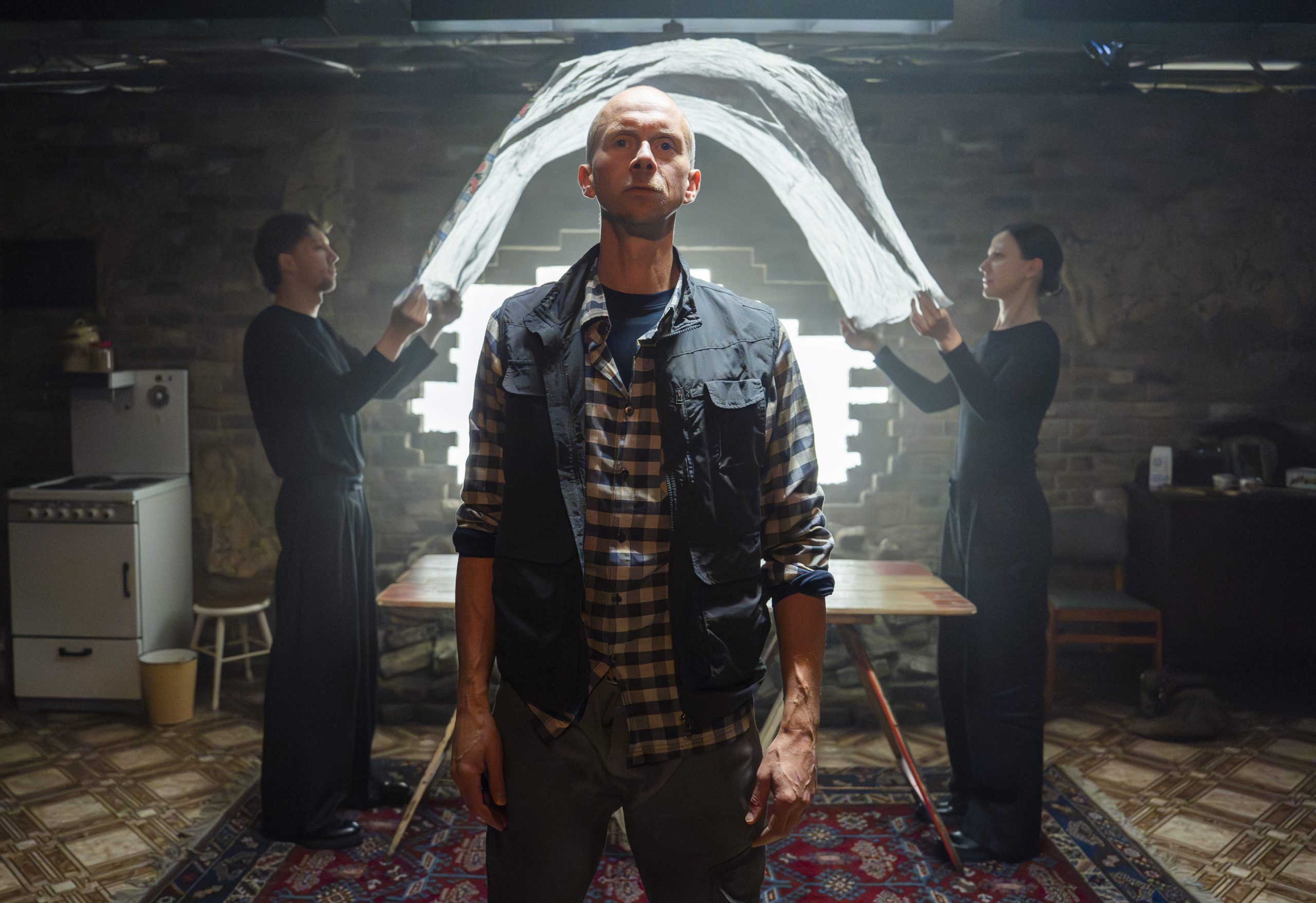
Actors Simeon Kyslyi, Tom Godwin and Olga Safronova in The Reckoning at the Arcola Theatre in London (2025). Photo by Tristram Kenton
AK: The other part is that all the people about whom we’re talking about, whose voices we are hearing, are not in the past but they’re very much living together with us. They can even come to see the play. Yes, this happens also a lot of documentary theatre, but I would say it usually doesn’t happen on this scale. People don’t usually talk about their husband being decapitated on the train station and then walking through dismembered bodies. Or talk about their children being killed and then having to abandon them on the road. So what is our approach to this type of stories? What kind of form can we choose?
And that’s how I think sometimes this post-Brechtian alienation sometimes helps just because then you can artificially create a distance that is lacking in my head when I’m talking about these stories. Then we can, on one hand, give an audience a bit of a breather so they’re not always in bloody tragic situations, whilst not distorting the stories completely and keeping them. I’m trying to find a new creative way to enter it.
But can I ask you a bit about it because you mentioned the difference between documentary theatre in different countries. How is it for you in the UK? Because obviously, we know, like the classical one. But how did it evolve for you right now?
JB: I mean, it’s a great question, and I’m not an expert in it. The most successful piece of documentary theatre that has happened in the UK over the last couple of years was the telling of Grenfell. Grenfell was the tower block in West London that was ravaged by fire in 2017. But my experience of doing a little bit of research into the work that’s being done with Ukraine and the telling of the stories of what’s happening in Ukraine is that it’s quite small. The audiences. It doesn’t feel impactful enough. The work was in small fringe theatres to small audiences of people. I fear that the work speaks to echo chambers and what I would really want to try to do with our work is to transcend the specificity of the precise location in Ukraine.
Certainly, we need to humanise this terrible tragedy that’s going on in Ukraine. We need to people to become more aware of it.
There’s a whole lot of obligations that I feel as a human and an artist not to hide these stories and not pretend that they’re not happening anymore. And for people to feel compelled to be more active in lobbying to stop the war.
But I also hope, with our theatre show that we can transcend the kind of specific Ukrainian-Russian situation. The Reckoning could be a conversation between a survivor and a journalist in Gaza. In our show, we build a connection between 2 people caught up in war where people can still form a relationship despite all the horror.
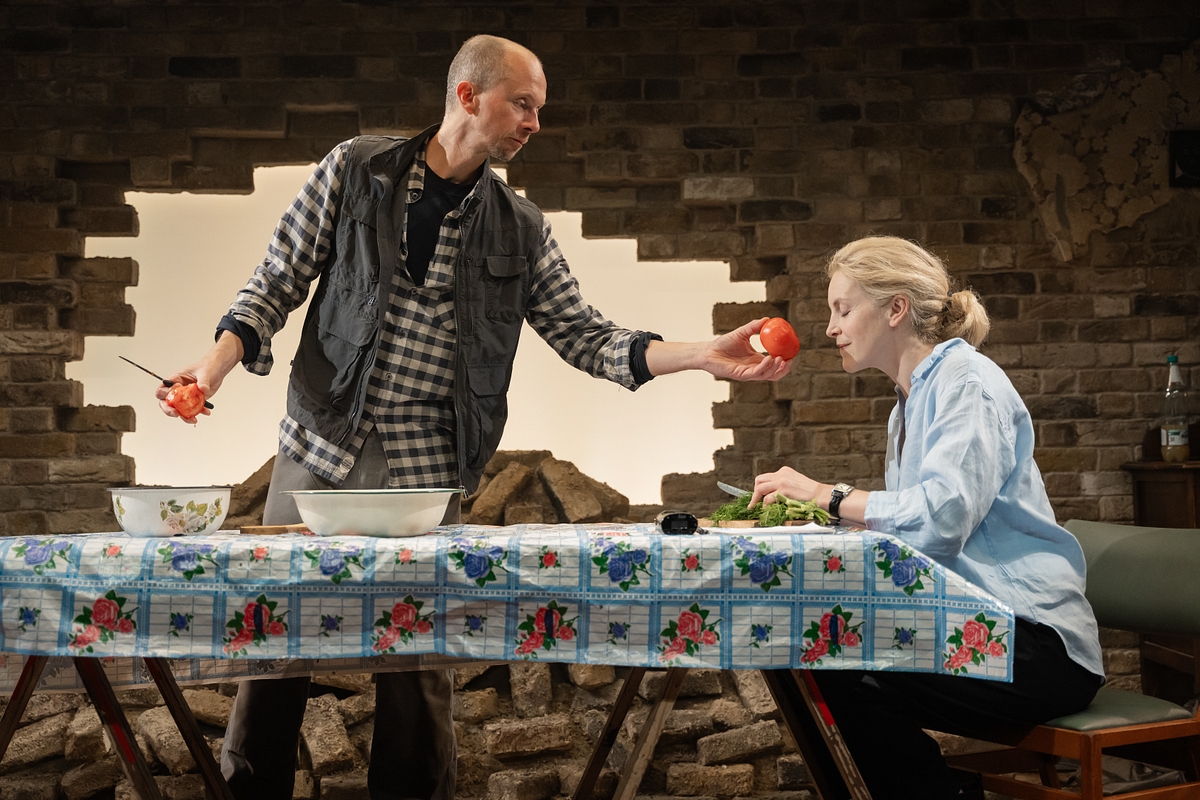
Actors Tom Godwin and Marianne Oldham in The Reckoning at the Arcola Theatre in London (2025). Photo by Ikin Yum
The other thing that I feel I’ve thought a lot about as we’ve been writing the show is the role of the journalists in the war. In our play, we’ve focused on not just the survivor, the testimony that the witness gives, but also the journalist who receives it. The role that the journalist plays in gathering these testimonies in order to ensure that there might be some justice for this survivor. We’ve made a piece that looks at what it is to absorb these testimonies and be physically impacted by hearing these stories. What I hope we will be able to achieve through our show is that there’s a breaking of the fourth wall in some ways, because the audience is also becoming the witness in that moment. It’s not just that we, the audience, are also hearing these stories, we are also becoming responsible for the stories. And it feels like moving the bearing of the witness beyond the show into the audience feels really important and powerful. There’s a responsibility and obligation that my company Dash Arts has to think about. How do we support the audience beyond the show? How do we support them to do something about the fact that they’ve heard these survivors’ stories and they are now responsible. They now have a responsibility to look after them, but also to act on them. So there’s a whole kind of aftercare support that needs to happen, but also the provision of information that we need to be offering people to stay involved that lives beyond the life of our show.
AK: Okay.
JB: Do you have anything else to share on that?
AK: I mean, not really. I think we’re more or less covered all of our work. I wanted to ask you, because we talked a little bit about the involvement with the art therapist. But did you actually have some kind of tools that you got from the consultation with her that you now use in your work?
JB: I think the main one was the things that I’ve been thinking about, that I’ve got from her from my own work, has been looking after myself. Also: not using the word ‘trigger’ anymore. There were some very specific things that helped me understand the testimonies. Based on some therapeutic ideas that she brought – how to understand the different stages of grief for example.
Also when we brought her into the rehearsal room. We’ve not really talked about how extraordinary it’s been to work with actors, with artists. Then it was very useful for me to have her there, holding space, thinking a lot about not just creating a space where people feel held and secure and safe but also how to leave the rehearsal room, the ways to shed the burden of the responsibilities of these testimonies that you’ve been reading, and the stories you’ve been telling and kind of take them off you with care before you go back out into the world. I’ve been thinking about that and using that a little bit in my work since then. What what about you?
AK: But this is the same as with you. I’m just thinking that it’s generally a big question for me always. I mean, I’m very pro therapists, and like psychologists in general. I’ve been in therapy for many years. But their involvement in theatrical processes is always a big question because it’s not that much common in Ukraine. In all the projects with soldiers we do have psychologists, but there is still a very big stigma around going to therapy, especially for soldiers. So they are missing these sessions and missing these meetings. Sometimes I think that maybe the theatrical process does always connect with all this nice advice about how to make work in a healthy way. Maybe sometimes, you know, you actually have to have a creative fight to get somewhere more productive.
JB: Sorry. Say that last bit again. You were saying you’re not sure that therapy helps?
AK: In terms of creating a play. Yes, sometimes I feel like maybe it doesn’t help. I sometimes have a feeling it’s not that useful. But it’s good to have a psychologist nonetheless.
JB: Just because it’s an interesting radical provocation, are you suggesting that sometimes in order to really go to somewhere to have a discovery in the text, you do need to go into these difficult dark places rather than be protected from them.
AK: This is something that we at some point talked about with my friend Roza Sarkisian. She’s a big fan of actually having a productive fight at some point in the process, like with actors, which is quite a specific way of doing theatre. But it works in her place. In mine, not that much. For her there are actors who give their own testimonies, their own thoughts, and at some point everybody is fed up with everybody, and then there is so much energy around the room that it’s not spoken about. Then you maybe have to finally sit down and say Okay, I hate you and I hate this process, and I want to leave. But then somehow, the play improves but anyways, our conversation has gone off in a weird direction!
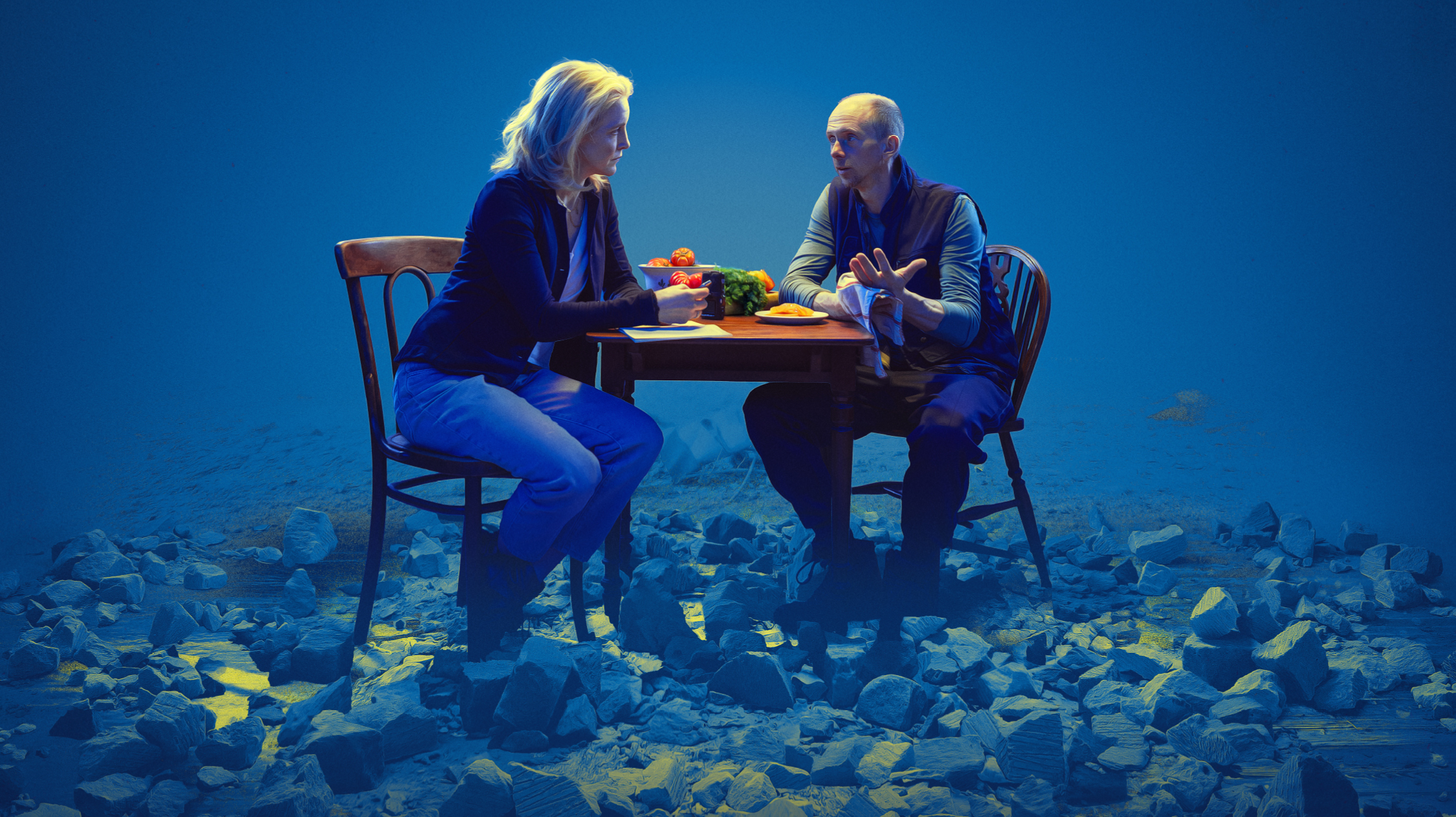
Promotional Image of The Reckoning by Dash Arts featuring Marianne Oldham and Tom Godwin sat at a Kitchen Table in conversation over the preparation of a Ukrainian Summer Salad. Photo by Rich Lakos, Design by Desk Tidy Design
Josephine Burton is a playwright, dramaturg, director, and Artistic Director of Dash Arts, which she co-founded to create award-winning cross-artform work connecting audiences with global stories. She co-wrote The Reckoning (Arcola, 2025), a bold theatrical response to the war in Ukraine, and The Great Middlemarch Mystery (Coventry City of Culture, 2022), a reimagining of George Eliot’s world through contemporary Britain. As dramaturg, she has shaped projects including Songs for Babyn Yar (Munich Kammerspiele, Theatre Podil, JW3), commemorating Holocaust memory through music and testimony. Alongside writing and dramaturgy, she has directed numerous productions that blend lived experience with innovative theatrical storytelling.
Anastasiia Kosodii is a Ukrainian playwright, director, and one of the co-founders of the Theater of Playwrights (Kyiv). Before the full-scale Russian invasion, Anastasiia often worked with NGOs in Eastern Ukraine in towns on the frontline. Her international work is connected with Maxim Gorki Theater (Berlin), Münchner Kammerspiele Theater and National Theater Mannheim.
