
Vitaliy Chenskiy
Following the outbreak of the Russian-Ukrainian war, contemporary Ukrainian playwriting has undergone a surge in production of new plays and the rise of a new wave of authors. Yet, alongside this growth, is an increasing sense that the space for artistic expression is narrowing. More and more plays seem to unfold within a clearly defined socio-political framework—confined to a set of pre-approved themes. This sense of predetermination, as I see it, is largely linked to how Ukrainian playwrights today view their own role in the current situation. The concept of theatre as a means for social transformation has become one of the central convictions. At the same time, my practical experience—both as a playwright and as a participant in creative collectives within the Ukrainian context—suggests that, throughout the war, many authors have primarily understood this conviction as a direct alignment with state strategies of cultural weaponisation. My doubts regarding the creative potential of this approach led me to closely consider the discussions that playwrights themselves sometimes start—specifically, debates about ‘how one should write about the war.’ The ease with which participants in these discussions reached consensus—along with the overall tone of agreement—only reinforces the critical stance I had taken from the outset.
At some point, I started searching for a conceptual anchor—a reference point around which I could organise my further reflections. It centres on the issue of a lack of authorial autonomy. The dissolution of the playwright’s perspective under the mobilising pressures of war became, for me, the observation that led to this particular formulation. By autonomy here, I mean not the political escapism of the creator but rather the foundation for their quest for liberation from subservience to the prevailing political landscape.
What furthered my development of this line of thought were the texts by British scholar and critic Claire Bishop, especially her 2012 book Artificial Hells: Participatory Art and the Politics of Spectatorship, in which she questions the widespread and overly optimistic belief in the effectiveness of art with an emphasised social mission. This critical perspective proved especially significant in the context of Ukrainian playwriting, where the rethinking of the author’s role as a social and political actor, in my view, had scarcely occurred.
On the other hand, a major contribution to my understanding of the absence of autonomy in Ukrainian playwriting was significantly shaped by the work of French philosopher Jacques Rancière.1 Since contemporary Ukrainian drama defines itself as political and socially responsible art, it seems appropriate to view it not only within the framework of theatre criticism but also through the lens of political philosophy. With this in mind, Rancière’s model served as a tool that opened up a new perspective for me. The philosopher employs the concepts of police and politics to delineate the fundamental framework of any political process. As I see it, contemporary Ukrainian drama today functions entirely within the realm of the police – maintaining hierarchies and smoothing out contradictions. In this context, it aligns with the mechanisms of martial law. In my view, this results not only from external circumstances but also from a lack of authorial autonomy—a loss of the very ability to choose that allows one to go beyond predetermined frameworks and to create unexpected, unprogrammable meanings.
Pathos of Modern Ukrainian Drama
Few things reflect the state of Ukrainian playwriting more clearly than its playwriting competitions. It is worth mentioning that the number of new plays submitted to various competitions has been increasing during the war. For instance, Драма.UA (Drama.UA) received 106 texts from 76 playwrights in 2021. In 2023, this competition accepted 139 texts from 111 authors and groups of authors.2 Another significant contest, Тиждень актуальної п’єси (The Week of Actual Play), received 75 texts in 2024 compared to 58 in 2023.3 Jury members, renowned writers, critics, and directors, who typically serve in this role, point out the considerable number of noteworthy debut texts submitted to these contests. Indeed, there are many new names on both the longlist and the shortlist for 2024. We may also engage in a discussion about the third wave of young Ukrainian playwrights over the past 15 years. The most intriguing aspect of this wave, in my view, is the rise of combatant playwrights—writers who possess firsthand military experience. It would be difficult to consider this a new development in Ukrainian literature, as combatant writers have already established their presence in ‘trench prose’ since 2014. However, it was only after 2022 that writers of this kind began entering the realm of playwriting. For instance, one of the most notable new playwrights is Alina Sarnatska. Her striking debut autobiographical play, Баланс (Balance), which explores the everyday lives of military medics in the autumn of 2024, rightly garnered two theatrical awards (The Week of Actual Play 2024; Липневий мед 2024 (Lypnevyi Med 2024).
At the same time, I would hesitate to call this a shift in kind (i.e., opening new territory/forms): rather, despite all the outward signs of activity, it seems to be a continuation of a long-established trajectory, within which Ukrainian theatre is embedded in existing societal frameworks and reproduces already established positions. Meanwhile, I had already noted that within the theatre community, there was hardly any emergence of autonomous groups attempting to create new, unexpected aesthetic-political platforms. It seems to me that shared idea of social responsibility among Ukrainian playwrights was mainly seen as an internally embraced duty to represent the ‘right’ dominant ideological positions in their work.
For many years, I participated with great interest in conversations and discussions. My primary dissatisfaction was that the Ukrainian theatre community did not act as a conduit for provocative meanings or unsettling impulses capable of infusing the cultural process with energy and unpredictability (of course, I cannot exclude myself from this dynamic). Energy was mostly channelled into debates about ethical questions within the theatre itself. As for creative work, its autonomy was steadily diminishing—which, in fact, reflected the political process in the country, which was becoming increasingly polarised, closing off intermediate spaces.
The full-scale Russian invasion reinforced this specific form of ‘to be engaged’ stance, understood here as supporting the state’s official position and ideology. The term ‘culture is a weapon’ has been legitimised in public discourse. Many authors view their work mainly as a fierce struggle in which they use, knowingly or not, political messages and government narratives. This pattern can be observed, for example, in how one of the evaluation criteria in the contest The Week of Actual Play is formulated: ‘Does this text bring the victory closer?’
Renowned Ukrainian playwright Maksym Kurochkin urges colleagues to synchronise their creative strategy with the political efforts of the authorities. During a discussion at the Фестиваль перших пʼєс | Театр Ветеранів |ТРО Медіа(Festival of First Plays | Veterans Theater | TRO Media) he stated that playwriting should rather follow a well-known narrative that is used by Ukrainian diplomats internationally:
I believe that drama, which we pursue professionally, can save everyone. Saving Ukraine also means saving the world. For me, these are indispensable matters, as we recognise that this is not merely a local conflict, but one that mirrors profound patterns of global processes… It seems we find ourselves on the brink of these global processes, and it is our responsibility to help save the world with our stories.4
Kurochkin is the author of the idea and co-founder of Kyiv-based Театр драматургів (Theatre of Playwrights), a primary centre for facilitating and presenting new drama.5Even at its formation stage in 2020–2021, the Theatre of Playwrights sought to play a state-centred role in shaping a national playwriting identity for Ukraine. After February 2022, the Theatre of Playwrights’ activities became entirely subordinated to the dominant political powers and social forces in Ukraine.
In this regard, Alina Sarnatska, the playwright debutant mentioned earlier, stands out to me as a compelling example and symbol of modern Ukrainian playwriting during the war. She was a civil and political activist and a member of the right-libertarian party Демократична сокира (Democratic Axe) until December 2021.6 She served in the army and holds the rank of sergeant of the ЗСУ (ZSU/Armed Forces of Ukraine), also works as a host of political programs.7 For Sarnatska, art serves as a continuation of her public activism through different means, and her reputation as a defender of Ukraine lends her work and statements a unique moral weight. The experience of war has rendered ethical legitimacy an essential aspect of both creative work and an author’s identity.
Overall, one cannot say there are no reflections on the political engagement of Ukrainian drama. Ukrainian playwright Natalka Vorozhbit, author of the most renowned wartime play about Ukrainian women refugees, Зелені коридори (Green Corridors), expresses herself most effectively and frankly. The play was initially written for the Münchner Kammerspiele theatre and German audiences.
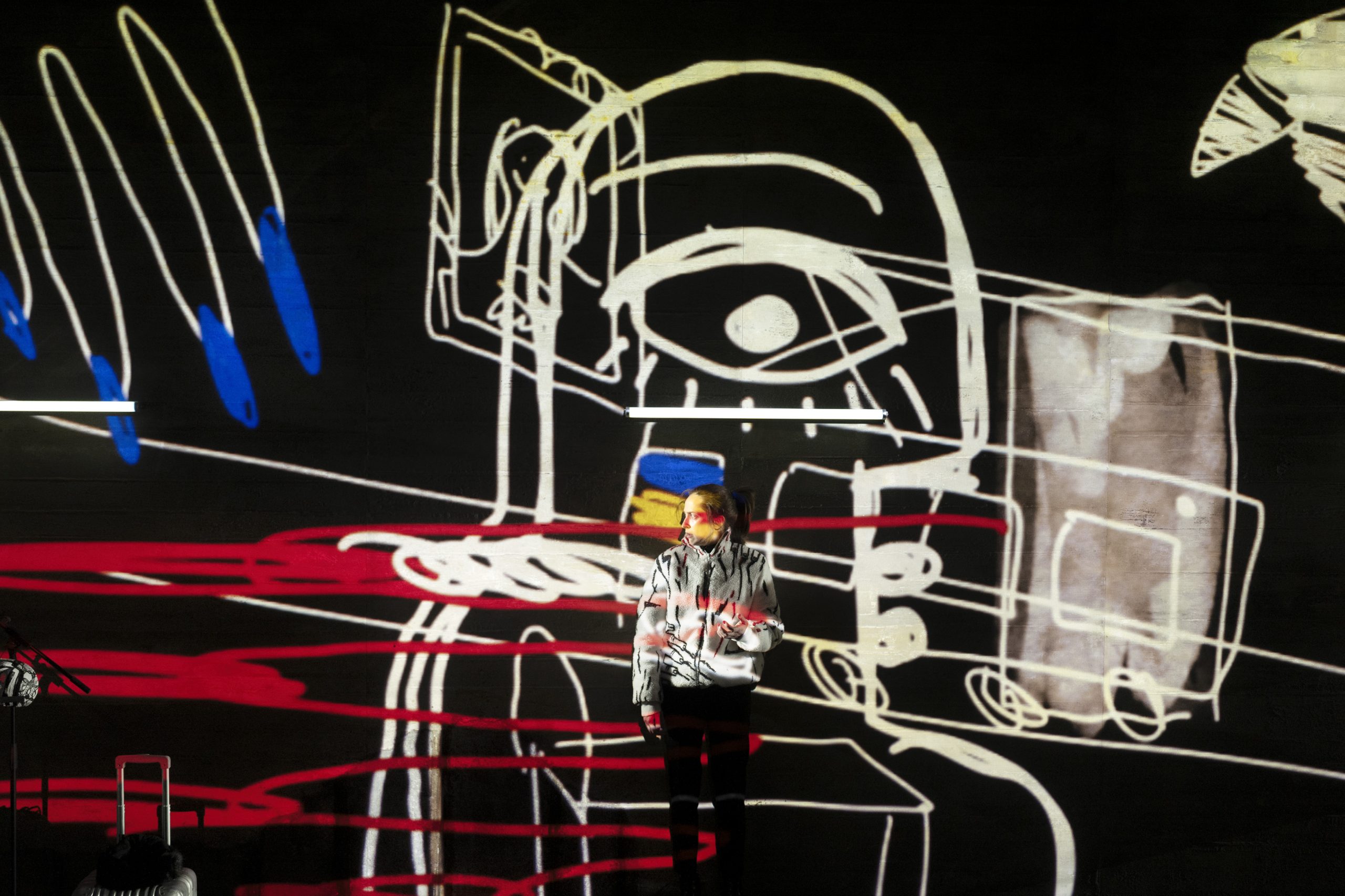
Scene from the play Зелені коридори / Green Corridors, written by Natalka Vorozhbyt and directed by Jan-Christoph Gockel, Münchner Kammerspiele, Munich, 2023. Photo: Armin Smailovic / Münchner Kammerspiele.
During the discussion Як говорити про війну в театрі під час війни (How to talk about the war in the theatre during the war), Vorozhbit said of her work on the play:
It’s frightening to realise that you are becoming a politically biased author. Now, politics dictates how you write. You must think about it constantly; you need to consider whom you are telling the story to, what they must understand about us, and what elements of propaganda should be included.8
In an interview with Українська правда (Ukrainska Pravda)9, Vorozhbit also said: ‘I have a feeling that here is where the art ends – where too much civic responsibility appears. The world has become black and white, and art is probably coloured.’10
Is my playwriting engaged enough in the struggle?
The question of art’s autonomy – as I propose to understand it here, meaning the right to inner complexity, to deviation, to untimeliness – has been almost entirely absent from public discussion during the war. On the contrary, many playwrights are still concerned with the question: ‘Is my playwriting engaged enough in the struggle? Should I be doing more to contribute, to resonate, to align?’
The entrenched perception of one’s own art as a tool of civic utility and a means of collective affirmation has, in my view, led to the formation of stable thematic and expressive patterns.
I offer a few brief examples.
One of the manifestations can be observed in a genre I would refer to as ‘the drama of pain and contempt’. Its authors draw on a set of emotions characteristic of ressentiment, with suffering and contempt serving as the two fundamental emotional pillars of this sociocultural phenomenon. Several notable Ukrainian playwrights have made their mark within this framework. A particularly illustrative example of this can be found in Lena Liagushonkova’s play Орден застелених лiжок (The Order of Made Beds), which was shortlisted for the international competition AVRORA: The Bydgoszcz Drama Award in 2023. As Olena Bondareva11 observes:
The mega-grotesque text The Order of Made Beds is dedicated to the anatomical dissection of Russians as a form of mental evil: Liagushonkova sends her potential readers/viewers into a Russian looking-glass world, where young men dream of becoming invaders and conquering the world; where mothers hopelessly search for their sons, whose corpses are never retrieved from Ukraine; where Russian pop music seeps from every crack; where the ‘population’ curses America and glorifies Putin; where a mother and a wife fight over a dead man’s money; and where Lenin chats with Russian women in the street.12
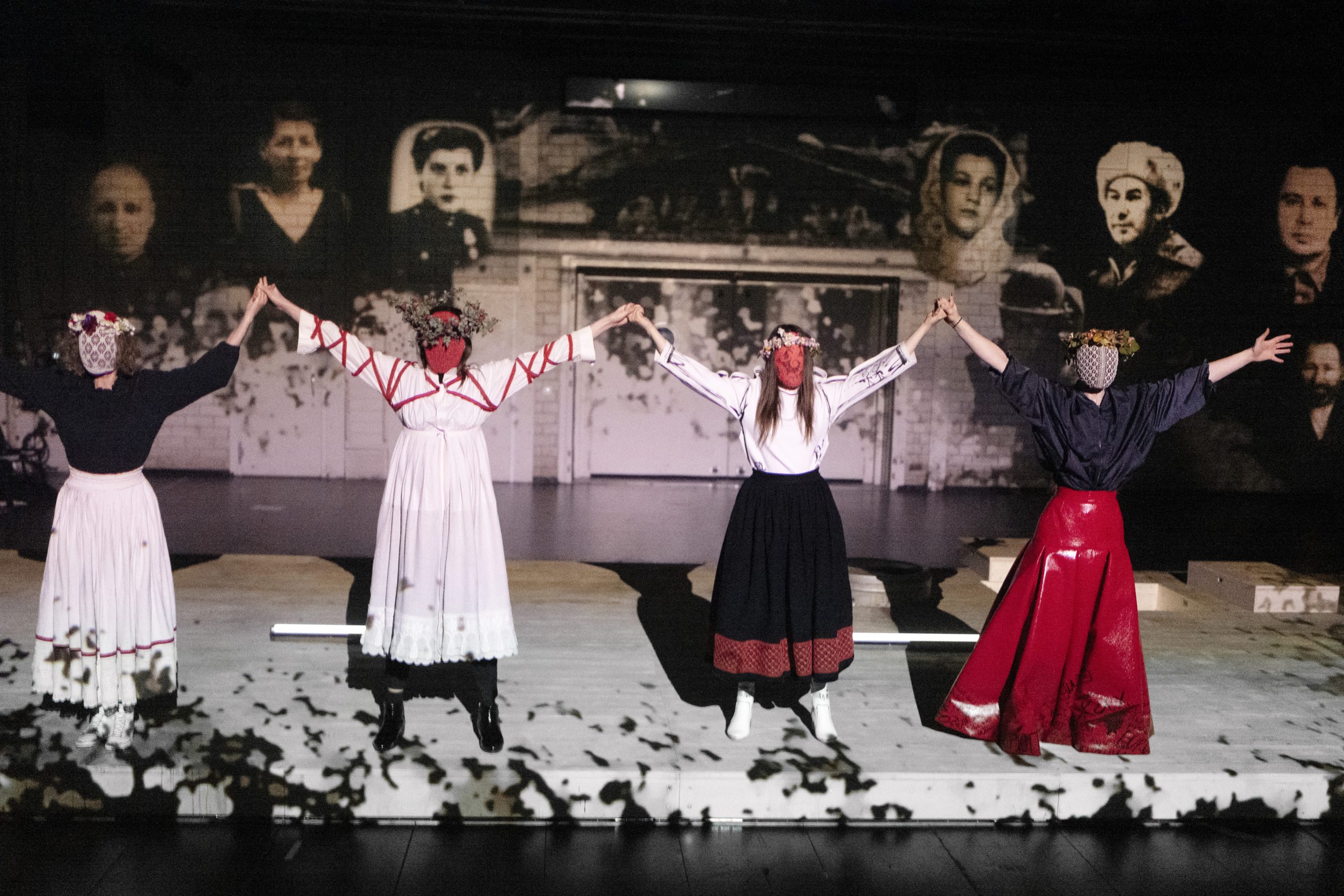
Scene from the play Зелені коридори / Green Corridors, written by Natalka Vorozhbyt and directed by Jan-Christoph Gockel, Münchner Kammerspiele, Munich, 2023. Photo: Armin Smailovic / Münchner Kammerspiele.
Another set of dramaturgical templates has emerged around the portrayal of Ukrainian refugees in playwriting. Those displaced by the war receive daily support within the European Union, yet they are often depicted as deeply misunderstood by their host societies. In scenes of casual interaction and dialogue in plays, characters often reproach Europeans for their superficial understanding of Ukraine’s struggle and what is seen as inadequate military assistance. For example, in Vorozhbit’s play Green Corridors, this is one of the emphasised messages directed at Germany. For me, this pattern illustrates how Ukrainian playwriting increasingly assumes the role of a collective advocate rather than that of an individual artistic inquirer.
In the portrayal of ordinary Ukrainians who stayed at home during the war, specific and easily recognisable dramaturgical choices have also emerged. The prosocial behaviour of characters depicted in everyday wartime settings is glorified. Simultaneously, portrayals of morally ambiguous or negative behaviour are also present in these plays. These transgressions are typically framed as consequences of psychological trauma caused by the military invasion or as inherited from the Soviet past. One recurring character type within this dramaturgical logic is a figure originally from eastern Ukraine, who embodies fragmentation, moral disorientation, inner discord, and the experience of a displaced Ukrainian identity. This pattern is evident in Kateryna Penkova’s Варвари цибулевої масті (Barbarians of Onion-Coloured Blood). The play was later revised in collaboration with Marek Jagielski and retitled Варвари (Barbarians), earning recognition at the 2025 Gdyńska Nagroda Dramaturgiczna (Gdynia Drama Award). I believe this reveals a characteristic interpretative habit. Many Ukrainian playwrights tend to view themselves as participants within the realm of public action. Consequently, they often favour an analytical approach based on social determinism. In my view, this narrows the scope of dramatic expression and, at the same time, diminishes the author’s autonomy – their ability to be ambiguous, to retreat, and to freely oscillate in meaning.
Another trend is a movement toward moral dualism. One of its effects is the established image of national innocence – a portrayal of Ukraine as an inherently good nation subjected to external malevolence. The prominent Ukrainian playwright Oleg Mikhailov, currently enduring shelling in Kharkiv, elevates this notion in his play Станція “Перемога” (“Victory” Station”) to a level of philosophical pathos influenced by Jean-Jacques Rousseau, whose concept of innate human goodness aligns with the depiction of a blameless nation suffering from foreign aggression.
While hiding from the shelling in the Kharkiv metro with other Ukrainians, one of the characters in the play—historian Bohdan Yuriyovych – shares how, in his youth, he participated in the archaeological excavation of an ancient, now-extinct human settlement in the Kharkiv region. Bohdan Yuriyovych in the play says:
Here they were, living on their land. They fell in love, had children, worked, had fun, sowed and harvested bread, and traded with their neighbors. They were simple and carefree, just like us. Then the Huns came, and no one was left alive.13
A Voice of Suffering, A Voice of Authority
In my view, Maksym Kurochkin is one of the most prominent and dedicated representatives of mobilisation playwriting. However, even he recognises the emotional fatigue inherent in such a creative approach. During a roundtable discussion in Kyiv entitled Місце драматургії у сучасному культурному просторі (The Place of Dramaturgy in the Contemporary Cultural Space), held on 12 April 2024, Kurochkin remarked: ‘The resource of empathy has been exhausted… Already a large percentage of readings of Ukrainian plays abroad are formal readings… Our voice is still a voice of pain, a little childish, a voice a little infantile.’14
Playwright Oleg Mikhailov, too, reflects on the limitations of contemporary war-related playwriting. In 2023, serving as a jury member of The Week of Actual Play, he wrote:
I have read 58 plays sent to the contest. I am not ready to analyse them in depth yet, but I would like to note that it is probably the first time I have read so many similar plays in my practice. That is, the names of the characters and cities may differ, but the stories are identical down to the last detail. We are talking, of course, about plays about the war. And in general, there is a feeling that playwrights are tramping on the same small patch of ground, where 5 or 6 plots keep recurring.15
Maxim Kurochkin insists that the primary task for Ukrainian playwrights is to create cultural meanings that will act as mental weapons in the information war battlefield. To address the issue of insufficient new meanings, he proposes a rather traditional solution: to provide more systematic support, both organisationally and financially, to Ukrainian playwriting. However, this approach may not result in the emergence of new meanings but instead lead to a multiplication of those that already exist.
The extreme emotional involvement of playwrights, which has naturally developed since the onset of the war, has contributed to the prevalence of an agenda-oriented approach to playwriting. It seems increasingly clear to me that theatre is becoming a crucial part of the propaganda landscape. A thoughtful and inclusive discussion is essential—one that welcomes diverse perspectives and can critically reassess the very concept of politically motivated engagement in modern playwriting. Claire Bishop’s Artificial Hells develops an argument that goes beyond the analysis of specific artistic forms and addresses the shared underlying logic of politically committed artistic practices across different media. It is almost axiomatic that the symbolic capital of art can be mobilised for social transformation. However, Bishop demonstrates that, on one hand, the real-world outcomes of such art often fall short of expectations. On the other hand, in its pursuit of political or social goals, engaged art frequently sacrifices formal complexity, as well as critical tension, internal contradiction, and ambiguity—qualities that enable art to generate genuine reflection. As a result, it tends to lose its reflective dimension and begins to function primarily as a tool of ideological communication, even within its own symbolic domain.In my view, her critique resonates with the current state of Ukrainian playwriting, where the urgency of war often leads to a similar instrumentalisation of theatre at the expense of its artistic autonomy.
Jacques Rancière develops an important distinction between two interrelated yet fundamentally opposed processes: politics and the police. This distinction helps me reassess what is commonly termed ‘political theatre’ in contemporary Ukrainian playwriting. In his book Disagreement: Politics and Philosophy, Rancière explains that the role of the police is to maintain order by suppressing conflict, stabilising the social structure, and preserving hierarchy.16 During the war, Ukrainian theatre, in my view, has increasingly come to assume this police function – fixing roles, meanings, and acceptable forms of expression. Unlike the police, politics introduces dissensus – a rupture in the established order of perception that determines who is visible, who is heard, and who is recognised as a political subject. Politics disrupts the usual distribution of roles and positions, allowing those who have been excluded to make themselves seen and heard. He emphasises: ‘Politics runs up against the police everywhere. We need to think of this encounter as a meeting of the heterogeneous.’17 These ideas offer clarity about what constitutes political art – and who can be considered a autonomous playwright. In my view, the political aspect of Ukrainian playwriting has been increasingly marginalised. The reason for this is that the processes of consolidation, smoothing out contradictions, and establishing a military-administrative hierarchy have completely dominated in warring Ukraine. Thus, to be more precise in terms of political philosophy, Natalka Vorozhbit should have said that she is ‘frightened by the realisation that you are becoming a part of the policing order of authorship.’ In this sense, the play Barbarians of Onion-Coloured Blood by Kateryna Penkova provides, in my view, a telling enough example. The action of the play unfolds in Poland, featuring characters who are Ukrainian refugees, Poles, and volunteers. Penkova directly addresses a painful episode in the history of Ukrainian-Polish relations-the Volhynia massacres of 1943, during which Polish civilians were killed by members of the Ukrainian Insurgent Army. Today, this remains an extremely sensitive topic in public discourse among the current leaders and organisations of Ukraine and Poland. Undoubtedly, it is one of the notable texts of contemporary Ukrainian drama. However, despite its merits, Penkova seems more inclined to smooth over contradictions than to provoke new discussions or highlight moments of dissensus. Wittingly or unwittingly, she takes on the role of a regulating author – one whose function aligns with the logic of the policing order.
From Mobilisation to Autonomy — Notes Toward a Possibility
Looking back from where we stand now, I can’t help but feel that, since 2022, the space for free and independent expression in Ukrainian playwriting has been quietly shrinking under the weight of wartime necessity. However, at the heart of creativity, and this is its most fragile part, there is always a drive towards the impossible, beyond the utilitarian and the didactic. Even if Ukrainian playwriting does not currently display such a tendency, it is still worth remembering the inherent capabilities of art – and, above all, the author’s right to autonomy as a fundamental condition of artistic expression. I tend to see authorial autonomy not as conviction but as the ability to be surprised, or even shaken – or both – by something unexpected. It means meeting the world not with answers already in hand, but with a tentative offer made on your own terms.
One such example appeared in late 2023, when Polish playwright Krysia Bednarek collaborated with Ukrainian director Roza Sarkisyan on the play Fucking Truffaut / Bliadski Circus Queelektyw.
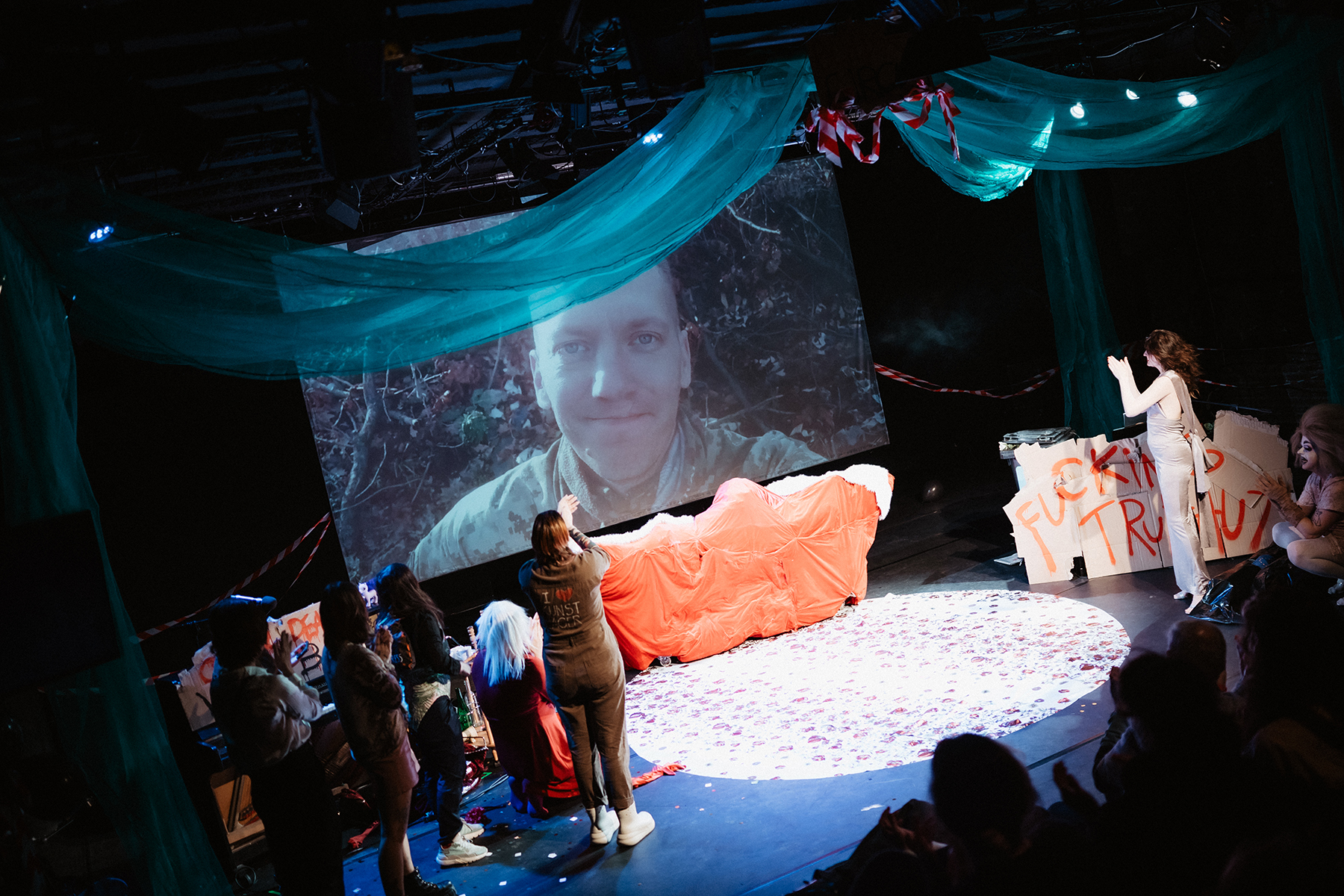
Scene from the play Fucking Truffaut / Bliadski Circus, written by Krysia Bednarek and directed by Roza Sarkisian, Teatr Dramatyczny im. Gustawa Holoubka, Warsaw, premiere in 2023. Photo: Karolina Jozwiak.
It was staged at Teatr Dramatyczny im. Gustawa Holoubka in Warsaw with a Ukrainian-Polish ensemble, and later presented at the Maxim Gorki Theatre in Berlin. The creators posed political questions to themselves and the audience: ‘Can we explore and discover new narratives surrounding military discourse? Is critical art viable at a time when all culture has been channelled onto a propaganda path?’18
These questions are unusual for Ukrainian drama, though one might wonder how fully their potential has been realised in this production. The fact that this production emerged on the edge of the Ukrainian cultural field also signifies the condition of this field in its theatrical context aspect.
What could the autonomisation of Ukrainian playwrighting resemble? I cannot offer a comprehensive answer here, primarily because there are many creative strategies. From a political philosophy perspective, this can be understood as a transition from the police component to the political. To begin with, this is impossible without practising the deconstruction of social mythology and ‘package thinking’ (pre-formed sets of beliefs, ideas, and evaluations). Additionally it requires a shift away from the principles of ethnocentric dramaturgy, which is founded on the ideology of national innocence. Consequently, playwrights could seek to highlight a still overlooked category of people whose voices are counted as noise rather than speech in public discourse. For instance, there exists an unexplored segment of individuals who evade military service.
According to Rancière, politics begins when those previously regarded as incapable of speaking suddenly become audible and significant to society. I believe that only art, which reflects on its own autonomy and broadens its scope, can engage with this process in a way that transcends mere declarations. Is this possible in a time of war? Perhaps, if one reframes the representation of art as a space for genuine experimentation.
Vitaliy Chenskiy is a playwright from Ukraine. His plays were shortlisted for the Week of Actual Play and Lubimovka. Publications include prose, poetry and plays in Union of Writers (Kharkiv) and documentary prose in Sociologie et sociétés (Montréal). Festival work includes Wild Osten (Theater Magdeburg, 2016) and Eine Brücke aus Papier / Paper Bridge (Mariupol, 2018). Stage works: Vitalik (Wild Theatre, 2018) and Aeneid XXI (Odesa Academic Ukrainian Music and Drama Theatre, 2020) — both winners of the GRA / Great Real Art Award. He was among the founding members of the Theatre of Playwrights. Awarded a Bavarian Ministry scholarship at Villa Concordia (Bamberg, 2023/24).

Notes:
- Jacques Rancière, Disagreement: Politics and Philosophy, trans. by Julie Rose (Minneapolis: University of Minnesota Press, 1999). ↩
- Drama.UA is a Ukrainian festival of contemporary playwriting, established in 2010 and based in Lviv. It serves as a platform for new playwrights and independent theatrical initiatives. ↩
- The Week of Actual Play is an annual Ukrainian festival of new writing, established in 2011 and held in Kyiv. It focuses on socially and politically engaged playwriting. ↩
- Територіальна оборона ЗСУ | ТРО Медіа, ‘Discussion at the Week of Actual Play 2023’, YouTube video, 26 November 2023 [accessed 26 March 2025] ↩
- Theatre of Playwrights is an independent theatre in Kyiv founded in 2020 by a collective of Ukrainian playwrights. It serves as a platform for the development and staging of new Ukrainian drama. ↩
- Democratic Axe is a Ukrainian right-libertarian political party founded in 2018. Known for its strong pro-military rhetoric and hardline anti-Russian stance, the party has actively participated in public demonstrations and civic campaigns supporting military aid and liberal economic reforms. ↩
- ZSU (Ukr. ЗСУ) is the abbreviation for Збройні сили України, meaning the Armed Forces of Ukraine. The acronym has been widely used in Ukrainian public and cultural discourse since 2014. ↩
- Театр Драматургiв, ‘How to Talk about War in Theatre During the War’, Facebook video, 7 May 2023 [accessed 26 March 2025] https://fb.watch/tEB7798urr/. ↩
- Ukrainska Pravda (Ukrainian ‘Truth’) is one of Ukraine’s leading news platforms, founded in 2000. It is considered a key publication in the country’s public and political life. ↩
- Tetiana Pushnova, ‘Про що соромно мовчати Наталці Ворожбит: кінець мистецтва, старі демони, новий роман і прірва між Держкіно і кіноспільнотою’ (‘What Natalka Vorozhbit Is Ashamed to Stay Silent About: The End of Art, Old Demons, a New Novel, and the Abyss between the State Film Agency and the Filmmaking Community’), Ukrainska Pravda, 8 March 2024 (accessed 26 March 2025) https://life.pravda.com.ua/culture/pro-shcho-soromno-movchati-natalci-vorozhbit-300426/. ↩
- Olena Bondareva – chief researcher at the Department of Ukrainian Literature at Borys Grinchenko Kyiv Metropolitan University. ↩
- Olena Bondareva, “Драма Панорама 2023” – новий формат українських драматургічних антологій (“Drama Panorama 2023” is a new format of Ukrainian dramatic anthologies), in Modern Philology: Theory, History, Methodology: Scientific Monograph (Riga: Baltija Publishing, 2024), pp. 67–68. ↩
- Oleg Mikhailov, Станція “Перемога” (“Victory” Station) (Ukrainian Drama Hub, 2023) https://ukrdramahub.org.ua/play/stantsiya-peremoha [accessed 27 March 2025]. ↩
- Maksym Kurochkin, comment made during the roundtable discussion Місце драматургії у сучасному культурному просторі (The Place of Dramaturgy in the Contemporary Cultural Space), Kyiv, 12 April 2024, available at: https://fb.watch/tHqPXM3Ry6/ (accessed 28 March 2025). ↩
- Oleg Mikhailov, post on Facebook, 7 October 2023, available at: https://www.facebook.com/Hrisaor/posts/pfbid02D2AGWE3fVRZncoyLRLyVbVTCiqNT38KusFRL36wf7RTQYSjjJFHVEaxa359wUvgzl(accessed 28 March 2025). ↩
- Rancière, Disagreement, p. 29. ↩
- Ibid., p. 32. ↩
- Fucking Truffaut, Maxim Gorki Theater (Berlin), https://www.gorki.de/en/fucking-truffaut/2023-11-11-2000 (accessed 31 March 2025). ↩