
Kasia Lech, Sofiia Onishchenko, Daria Bogdan and Vasylyna Martseniuk
Sofiia Onishchenko, Daria Bogdan and Vasylyna Martseniuk are Ukrainian actors currently living in Poland after they moved there as students of the Харківський національний університет мистецтв ім. І. П. Котляревського (Kotlyarevsky Kharkiv National University of Arts) in March 2024. Since then, they have created theatre, which they describe as “cultural resistance.”1 In the interview, they explain the idea and speak about studying in Poland, creating niezależny teatr GAS (незалежний театр GAS) (the independent theatre GAS) and curating the Ukrainian stage at the Instytut im. Jerzego Grotowskiego (The Grotowski Institute) in Wrocław.2
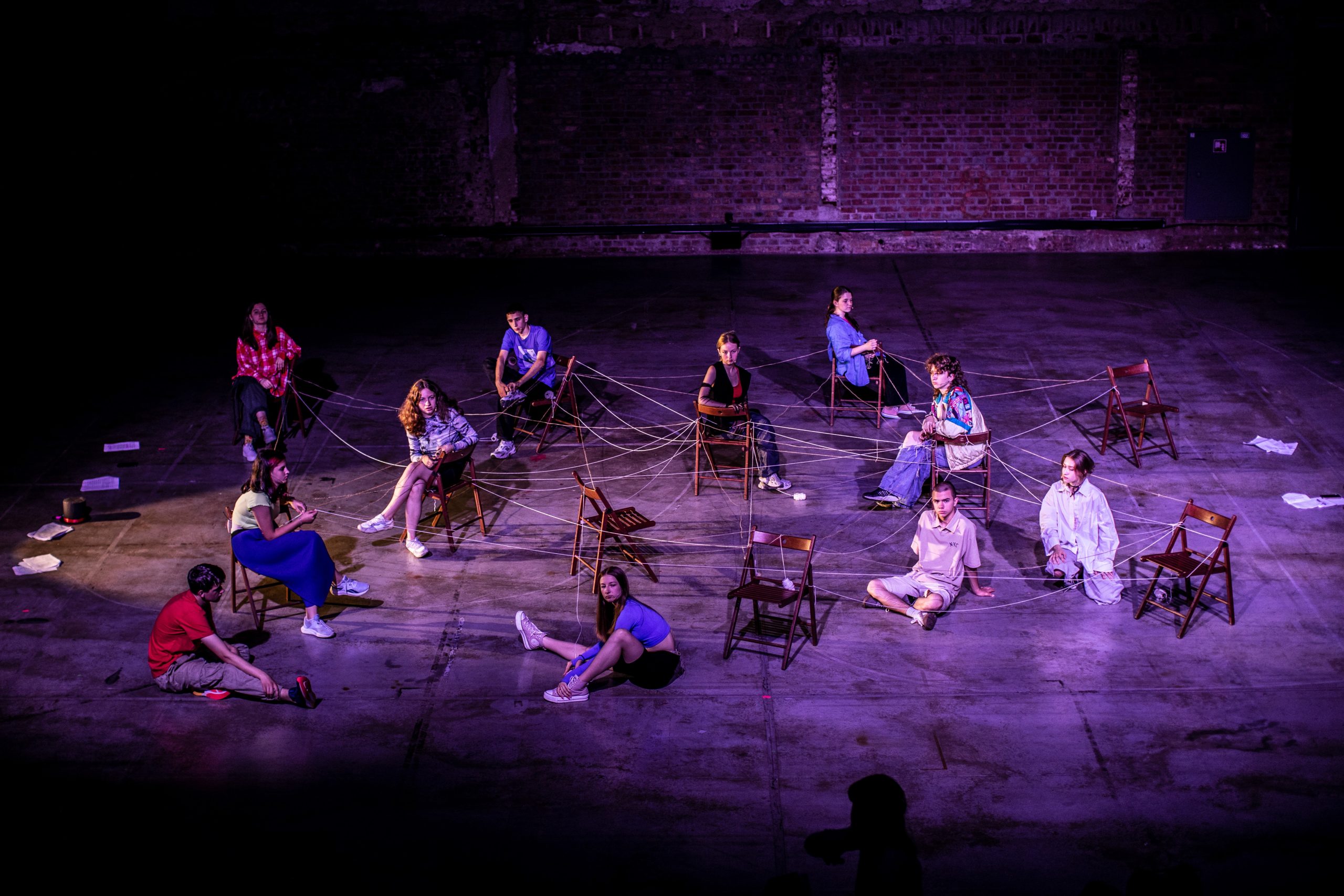
Jutro 10 lat temu/Завтра 10 років тому (Tomorrow, Ten Years Ago). Tomorrow, Ten Years Ago, directed by Sofiia Onishchenko and Daria Bogdan, teatr GAS (2024). Photo by Tobiasz Papuczys.
The interview was conducted online. Onishchenko and Martseniuk were responding from Poland, and Bohdan from Ukraine. I sent them questions in English, and they responded in Ukrainian and translated themselves into English (Onishchenko and Bohdan) and Polish (Martseniuk). I translated the Polish parts into English and edited the interview. In the interview, as requested by the three artists, russia is used (instead of Russia) to emphasise Onishchenko, Bogdan and Martseniuk’s feelings towards the country that for centuries has tried to annihilate Ukraine and anything that embodies Ukrainian identity.
Wiosna, lato, jesień, zima i znowu wiosna | Весна, літо, осінь, зима і знову весна (Spring, Summer, Fall, Winter, and Spring Again), directed by Sofiia Onishchenko, teatr GAS (2023).
Kasia Lech: How has your view on what theatre is and its role in society changed after the 24th of February 2022?
Daria Bogdan: During russia’s full-scale invasion of Ukraine, we can feel the need for theatre more acutely. Theatre is a space for shaping and expanding personality and consciousness and addressing complex, pressing questions. I think war is an experience that, whether you want it or not, expands consciousness, and theatre both exhibits and, in a way, legitimises the complexities of living through it. Since the full-scale invasion, theatre, once and for all, became political for me; it became about civic awareness and responsibility.
Vasylyna Martseniuk: My idea of theatre hasn’t changed. What has changed is how I practice theatre. My aspirations also changed.
Theatre is made by people for other people. People have unique experiences, traumas, illnesses, citizenships, and loved ones. All of these things meet in theatre through the tenderness of the spectator and the creator. After 24 February 2022, the arts have become an even more vital force in giving me a voice to express myself through who I am in building a bridge between spectators and Ukrainian culture.
Sofiia Onishchenko: Ukrainian theatre today is a platform for the values and meanings we are fighting for, especially for foreign audiences. The number of foreign visitors able to visit Ukraine during russia’s full-scale war has significantly decreased. Ukrainian theatre beyond the borders is an opportunity for the world to see and understand what Ukraine is.
Engaging in Ukrainian theatre today is also a form of cultural resistance against the actions of russian terrorists who daily destroy schools, museums, and theatres and kill Ukrainian artists. When the russians occupied my school in Кислівка (Kyslivka), the first thing they did was remove Ukrainian-language books from the schools.
When we staged the play Jutro 10 lat temu (Tomorrow, 10 Years Ago) with Ukrainian teenagers (ages 12-19) in Wrocław, we saw how theatre could be a vital support system for someone and a place for growth.
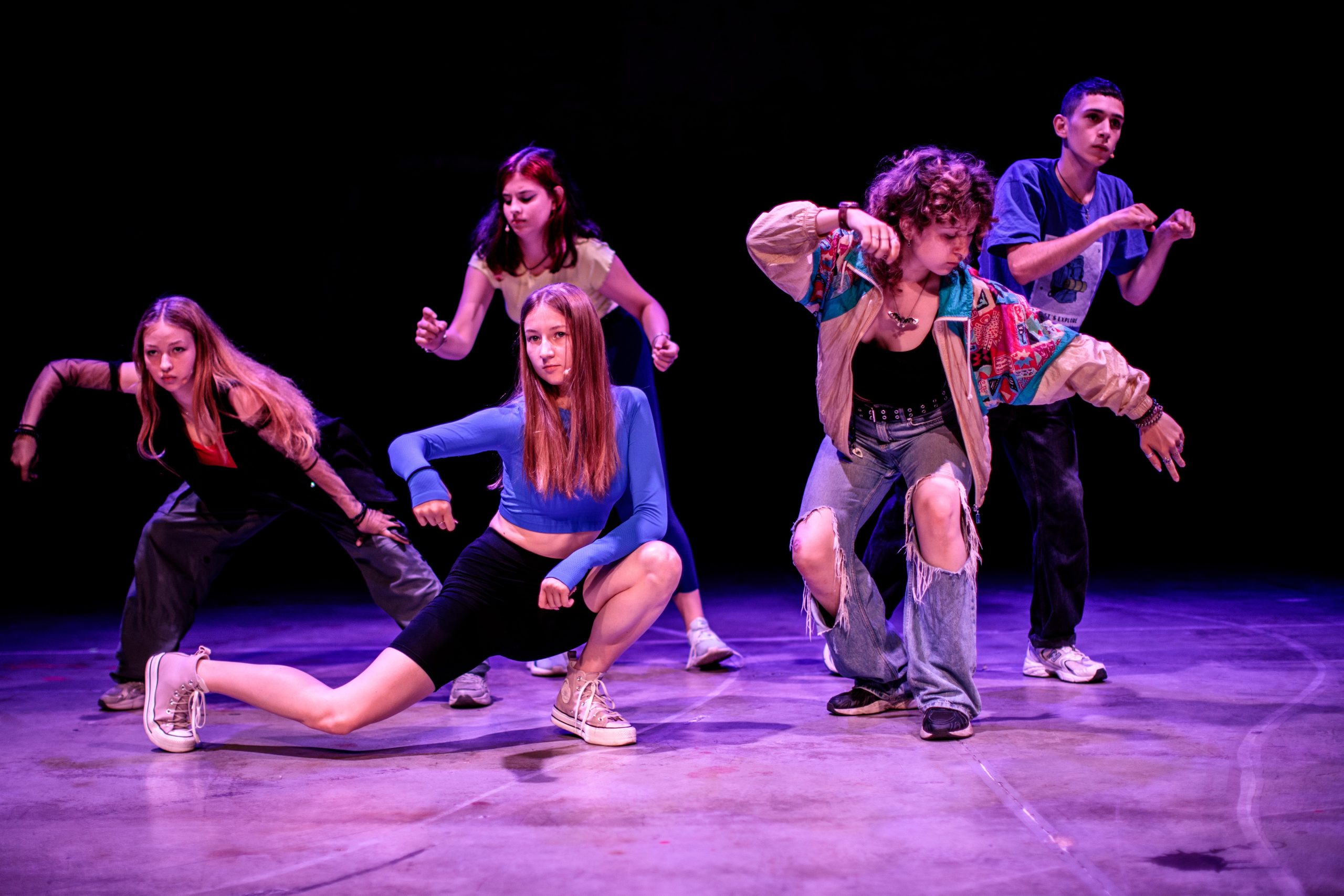
Jutro 10 lat temu/Завтра 10 років тому (Tomorrow, Ten Years Ago). Tomorrow, Ten Years Ago, directed by Sofiia Onishchenko and Daria Bogdan, teatr GAS (2024). Photo by Tobiasz Papuczys.
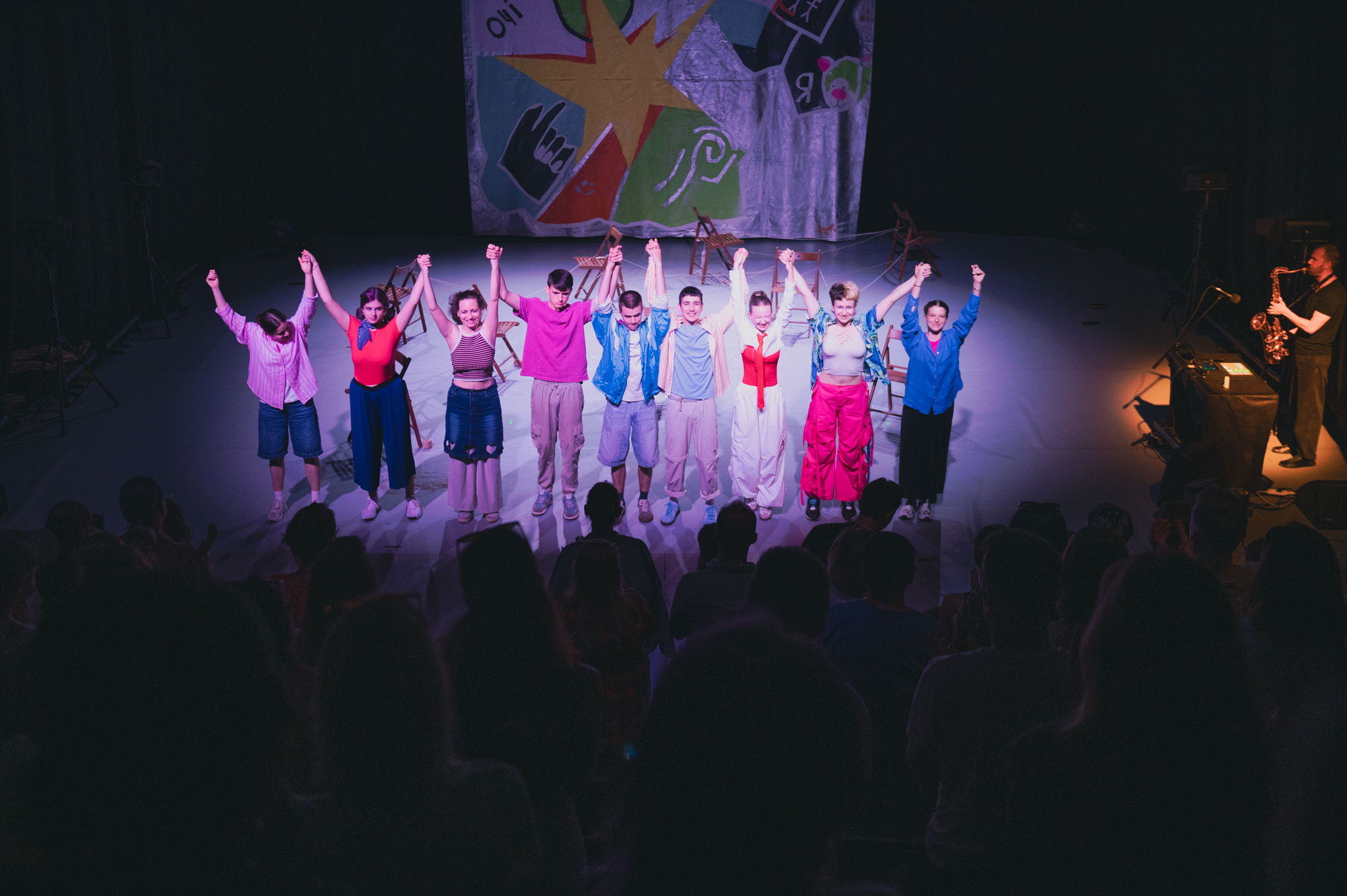
Jutro 10 lat temu/Завтра 10 років тому (Tomorrow, Ten Years Ago). Tomorrow, Ten Years Ago, directed by Sofiia Onishchenko and Daria Bogdan, teatr GAS (2024). Photo by Rafał Skwarka.
After the start of russia’s full-scale invasion of Ukraine, Ukraine has received military support from other countries but far from enough to protect the country and ensure safety in all Ukrainian cities and towns.
KL: In your work, you perform the history of Ukraine, including the one happening right now. Can you tell us more about it?
VM: Historia Ukrainy (History of Ukraine) was our first project. At the time, our theatre – the independent theatre GAS – did not yet exist. There were three girls and their three stories. This production brought us together when the three girls had just arrived in a foreign country, did not know its language and were ‘frighteningly fresh’ in their traumatic memories.
SO: We created History of Ukraine as a mirror-like response to the reality surrounding us.
DB: A month after arriving in Poland as refugees…
SO: We had Easter holidays and couldn’t travel to see our families, so we stayed at the Academy and had plenty of free time for rehearsals.
DB: It was our response to the circumstances we found ourselves in: the experience of full-scale war and displacement. This experience poured into the first performance, then another, and each new version of History of Ukraine.
VM: The piece changes with the flow of events.
SO: This play is crafted like a diary; each version reflects a specific slice of reality. When we first presented it at the Akademia Sztuk Teatralnych (AST National Academy of Theatre Arts) in Wrocław on April 22, 2022, Vasya’s hometown, Бахмут (Bakhmut), was neither occupied nor destroyed. Now, you’ll see ruins if you search “Бахмут” or “Bakhmut” on Google. Not a single building remains intact, and the city is under temporary russian occupation. In the earlier versions of the play, I had a scene with aerial footage of Kyslivka from the summer of 2021. Today, Kyslivka is also under temporary russian occupation, and all the buildings have been destroyed. It’s emotionally shattering for me to see my home as it once was and to know it will never be that way again. That’s why we removed this scene from the play. I found it impossible to maintain emotional distance from this subject; without that distance, performing on stage becomes unfeasible. Without distance, it ceases to be theatre and stops being emotionally sustainable for me as a performer.
DB: Our feelings and the political situation keep changing, and with them, we change, too, along with our performance. The uniqueness of this performance lies in its autobiographical nature. It has absorbed our experiences and given them back. For me, this performance is simple and ‘as it is.’ I mean, it’s not meant to be a grand show. It doesn’t have a masterful stage rhythm or a director. Instead, it is us and our stories, expressed through body, words, song, and the films we edited ourselves, projected onto the screen.
VM: At the same time, each staging of History of Ukraine is a small victory and a reminder that events change, time passes, people change, but the enemy remains the same.
KL: You mentioned the independent theatre GAS. This is a Ukrainian theatre in Poland, which you formed. How did you go about it?
DB: The GAS theatre emerged from the need to solidify who we are and to give shape to our performative and theatrical expressions. History of Ukraine was the seed from which our theatre grew.
SO: After the first performance, History of Ukraine became part of the student theatre’s repertoire at the AST Academy. We performed it at festivals in Białystok and Goleniów, as well as in Wrocław.
DB: GAS also owes its existence to the AST National Academy of Theatre Arts in Wrocław, which became our home for a while. It was where we created our first performance, but also because of the immense support we felt from the people working and studying within its walls. Later, we devised a fitting name for ourselves: *GAS* (with S to avoid using the letter Z).3 We were no longer just three girls from Ukraine: we were *GAS*!
SO: In April 2023, we received a proposal from the Grotowski Institute, specifically from Kuba Tabisz, to work with the Institute and establish the Ukrainian Stage—the first and only one in Poland. This would allow us to perform as GAS with our existing and future productions while inviting theatre companies from Ukraine. We agreed, and now we are in the second season of the Ukrainian Stage.
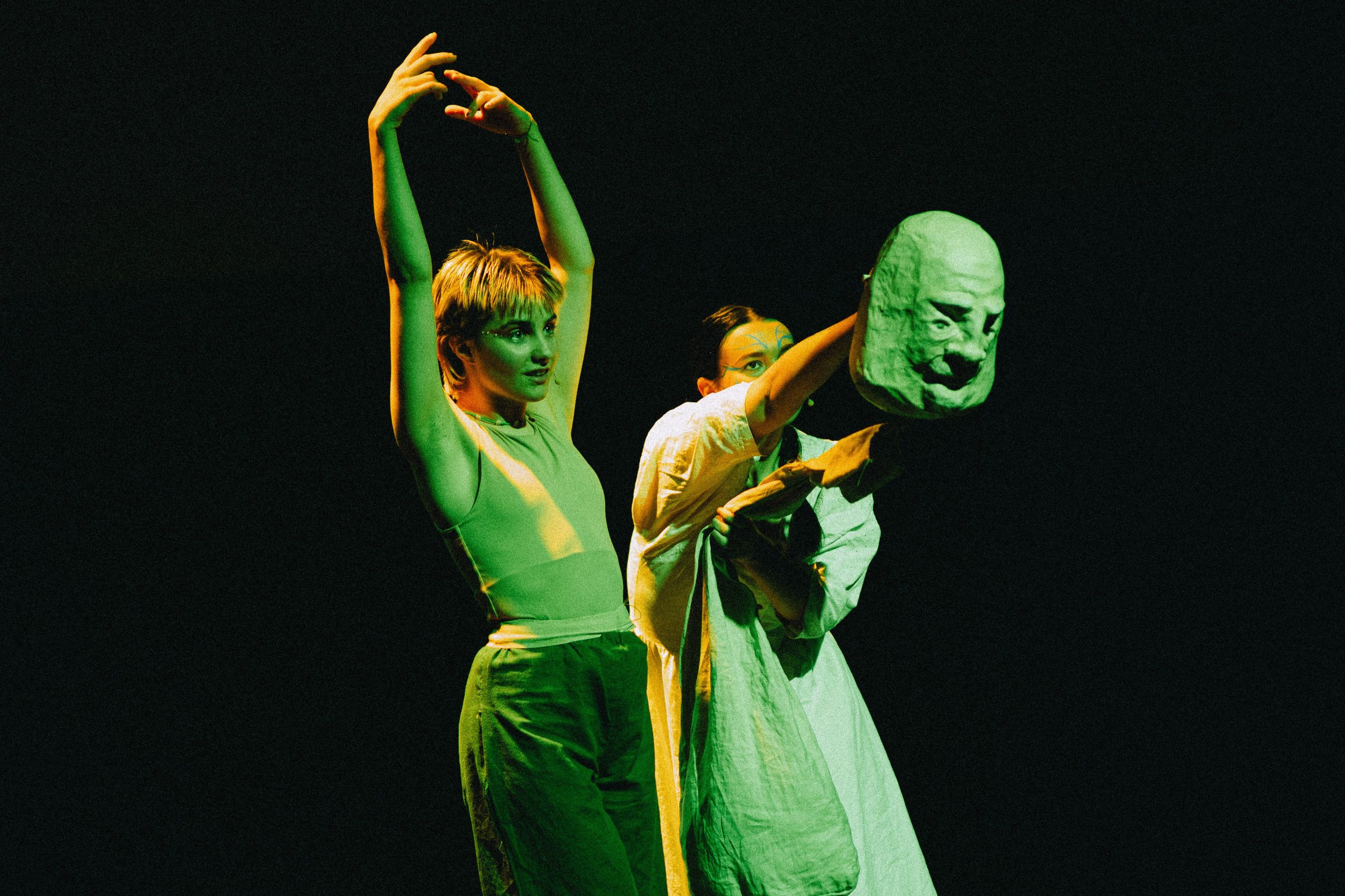
Wiosna, lato, jesień, zima i znowu wiosna | Весна, літо, осінь, зима і знову весна (Spring, Summer, Fall, Winter, and Spring Again), directed by Sofiia Onishchenko, teatr GAS (2023). Photo by Dmytro Mykhalakii.
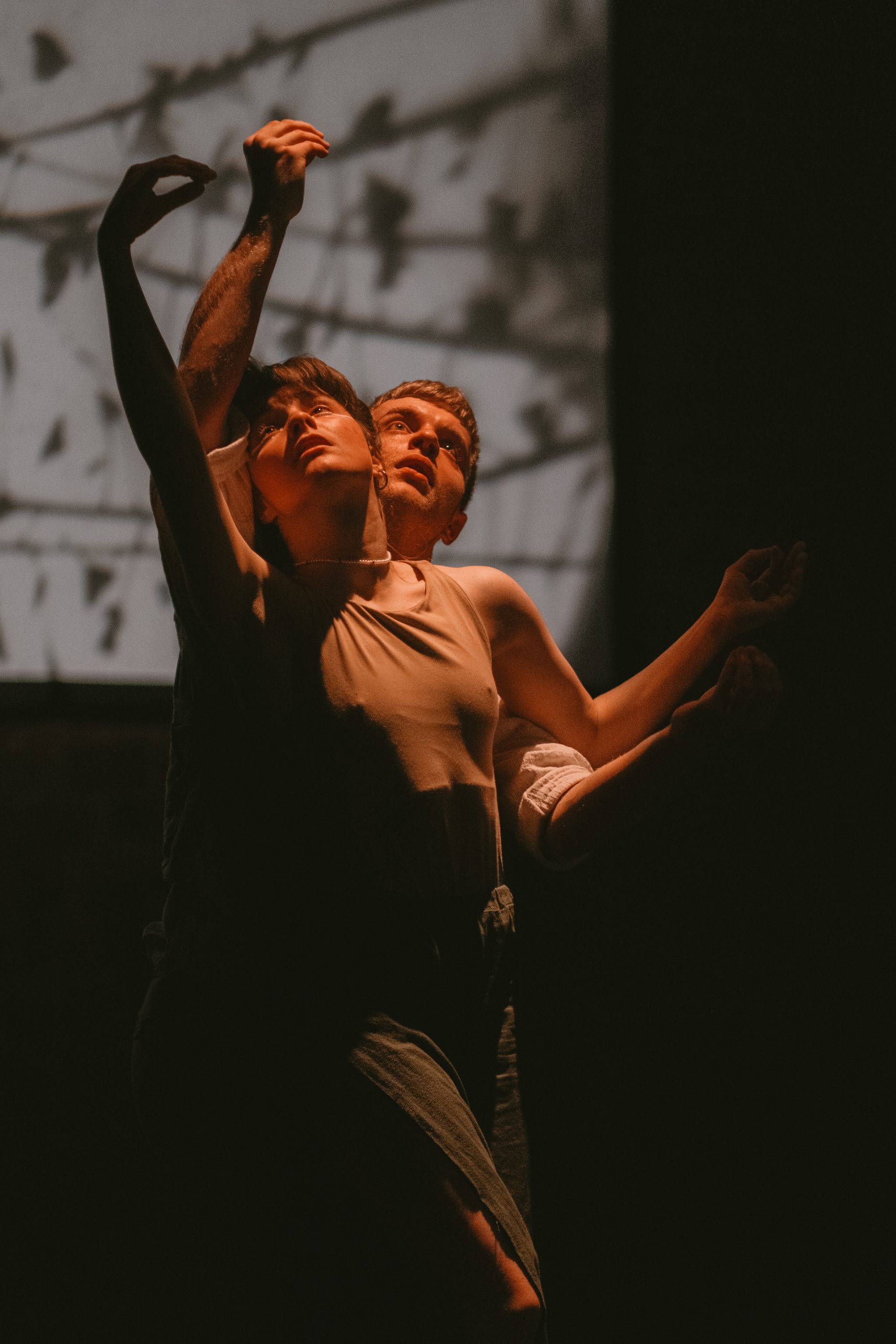
Wiosna, lato, jesień, zima i znowu wiosna | Весна, літо, осінь, зима і знову весна (Spring, Summer, Fall, Winter, and Spring Again), directed by Sofiia Onishchenko, teatr GAS (2023). Photo by Alina Metelytsia.
Our repertoire includes History of Ukraine, but also productions like Wiosna, lato, jesień, zima i znowu wiosna | Весна, літо, осінь, зима і знову весна (Spring, Summer, Fall, Winter, and Spring Again) and Jutro 10 lat temu/Завтра 10 років тому (Tomorrow, Ten Years Ago). Tomorrow, Ten Years Ago was co-made with teenagers from Ukraine who are now in Wrocław. We also create street performances, acting workshops, performative readings, and theatrical research projects. We organise two to six monthly events and have a theatre team of around 60 people.
VM: GAS and the Ukrainian Stage are not projects that have been planned for years. They are creative spaces that emerged from a burning initiative to create, act, show and share Ukrainian culture, love, strength, courage and many other values.
Kl: Who is your audience?
DO: People interested in Ukrainian culture.
VM: Initially, it was mainly Polish people, but then Ukrainians started coming. Now our audience is multicultural.
SO: And bilingual! Before each performance, we ask the audience to clap if their first language is Polish and then if their first language is Ukrainian. Usually, it’s an even split, which is a very important indicator because, in Wrocław, there is no other regular platform or space where people from Ukraine and Poland can encounter professional Ukrainian theatre together.
We also acknowledge the bilingualism of our audience. We don’t perform without two-way translation. If the performance is in Ukrainian, we provide Polish subtitles. If there are parts of the performance in Polish, we offer Ukrainian translation.
We want to be accessible to our two target audiences because we aim not to stay open to new spectators and their language and culture while at the same time maintaining a connection to home and its people with whom we share a common emotional and physical experience.
KL: What do you hope to achieve with GAS theatre?
SO: We want to be a hub for strengthening the Ukrainian minority in Wrocław, and to build a strong, conscious, and proactive community. We create opportunities to promote contemporary, young, and independent Ukrainian art while providing a platform for artists in exile to preserve and cultivate their national identity.
DB: People need art rooted in Ukrainian values, Ukrainians and people from other countries. Right now, Ukrainian artists are reflecting a unique experience in their work. War teaches us to lose, but it also teaches us to love radically. This is something unique that we can offer. People broaden their horizons through this kind of theatre, becoming (hopefully) more empathetic and conscious when they witness different destinies.
VM: If after our performance, at least one spectator becomes interested in Ukrainian culture, reflects on the country’s history, if a word or movement is internally imprinted in that person’s heart, and if that person wants to support the Armed Forces of Ukraine and the development of the theatre – that is what we hope to achieve. After each performance, we organise a donation collection for the Armed Forces of Ukraine (AFU), which, for me, is now an integral part of the end of every performance I take part in.
SO: Yes, this is an essential part of every show because our close friends, theatre mentors, and family members currently serve in the military. Knowing that today we perform a play, and tomorrow we can repair a military vehicle, buy warm clothing, power banks, or medicine for them helps us see how theatre can directly impact the war. This way, we also spread Ukraine’s donation culture abroad. In Ukraine, donations for the military are widely integrated into daily life. You can donate in many stores and cultural institutions. In the first season alone, from 23 events, we raised approximately 220,000 UAH [approximately €5029] for the needs of the AFU!
DB: On a different note, it would be amazing to organise educational camps with training sessions and laboratories and to take our work abroad. For example, I would love to show The History of Ukraine in Berlin.
KL: New solidarities across Central and Eastern European theatres have recently emerged, and especially more women artists work together. Who do you (hope to) collaborate with? With whom will you not work?
WM: Working with talented, expressive and conscious artists always brings new tones to the work.
SO: New collaborations and connections in the theatre are important for us, but we also want to share values with the people we work with,
DB: Exactly. I want to collaborate with people actively engaging in cultural policies and artistically asserting their rights. However, I will not collaborate with russian artists—this is non-negotiable for me. I find imperialist narratives repugnant. Collaborating with someone from russia means declaring an intent to seek resolution and reconciliation through culture, which is impossible as long as the military aggression and genocide perpetrated by russians continue.
SO: For me, this is also unacceptable, especially when my family in Kharkiv is under daily shelling by russia, and my friends are on the front lines.
WM: I cannot work with people who support Putin and Lukashenko’s dictatorship and russia’s full-scale war on Ukraine.
KL: You started training in Ukraine and are completing it in Poland. How has that impacted your understanding of your acting and the aesthetics of your theatre?
VM: Kharkiv and the Kotlyarevsky University of Arts are my foundation, my starting point, my heart, my inspiration, my childhood dreams, my experiences and my maturity. For me, Kharkiv is a city of youthful fierceness and rebellion. In my first year at the university, I was inspired by the independent Театр «Нафта» (Nafta Theater) in Kharkiv, and today our theatres work together. Finishing my theatrical education in Wrocław, I see that the inspiration from Ukraine has transformed into an activity, a plan, a structure – already in another country. The Wrocław Academy developed my old skills and discovered new ones. In Wrocław, a new space for artistic realisation grew out of the need and passion. My body and consciousness in professional acting have been shaped in Wrocław, but the heart, dreams and inspiration – are always in Ukraine.
DB: When I arrived in Poland, my identity began to expand and change rapidly, and this wasn’t limited to theatrical experiences. There were many new challenges and emotions.
Before the full-scale invasion, my theatrical life was rich and diverse. I loved my university and the Nafta Theater in Kharkiv. I cherished that time; it felt like a dream come true.
After the full-scale invasion, I found myself in a foreign country (which welcomed me warmly, but still, it’s a foreign country), not knowing the language and being in a completely new environment. Theatrically, it was challenging to grow at first. I felt divided, as if one part of me was emotionally at home while the other was trying to keep up with everyone else and receive a quality theatrical education. It was hard to act during heavy missile strikes while focusing on a distant future (getting a good education and eventually enriching Ukrainian culture). But I learned. I’m still learning.
At the Academy in Wrocław, they believed in me and did everything they (students and professors) could understand me, and I am grateful for that. I’ve learned to trust my acting intuition and believe in myself more deeply, though burnout was sometimes inevitable. But when it comes to aesthetics, I can say that I remain deeply committed to my Ukrainian roots.
SO: Since my teenage years, I dreamed of studying theatre in an EU country, but everything was going well for me in Ukraine, so I never pursued that idea. Now, studying at the Academy in Wrocław cannot be separated from the context of why I am here. I am here because of russia’s full-scale invasion because my home was destroyed. I didn’t compete in a highly selective admission process at the Academy in Wrocław but instead transferred from my university in Kharkiv.
That’s why I cannot say that I ‘enjoy’ studying in Poland. These words don’t fit the reality we are living in. What I can say unequivocally is that the Academy in Wrocław is the best thing that could have happened to me during russia’s full-scale war. I am receiving a high-quality European theatrical education, an important foundation for returning to Ukraine and working on Ukrainian cultural and artistic projects.
The Academy in Wrocław has given me a strong practical base, which was impossible in Kharkiv because my Ukrainian university has been operating online for nearly three years due to constant russian shelling. Performing in another language has been an entirely new experience. Sometimes, I had to grasp the meaning of a scene through the melody of the language rather than the words themselves.
In Wrocław, I began paying more attention to actors’ body language and their methods of delivering text, rather than focusing solely on the words. When I arrived in Poland, I had no prior preparation—I didn’t speak Polish at all at first. On a personal level, the full-scale war against Ukraine, coupled with the constant danger faced by my loved ones and family back home, inevitably affects my state of mind here. Acting is deeply tied to emotional expression, a profound understanding of your body, and the tools you use to convey emotions. When daily tragedies unfold at home, your psyche constantly adapts, searching for new mechanisms to cope and continue working.
For instance, there was a day when I had to perform a comedic sketch with Muppet puppets for an exam. It was autumn, the weather was already quite cold, and a massive attack occurred across Ukraine. I couldn’t reach my sister by phone, and just a few minutes later, I had to step onto the stage. Moments like that demand immense effort—to make a choice, negotiate with yourself, and find tools that allow you to protect your mental health while fulfilling your academic responsibilities.
Everyone probably has their own methods. I prioritise my mental state above all else, and only then comes theatre. This same principle is written into the constitution of the GAS theatre. If I can maintain control over my emotions, I start performing.
Pursuing acting during the largest war in Europe since World War II seems almost absurd. Yet, at the same time, culture during war plays a vital role in preserving self-identity.
Sofiia Onishchenko is a Ukrainian actor, director, and performer born in Kyslivka, Kharkiv region. She studied theatre directing and animation theatre acting at the Kotlyarevsky Kharkiv National University of Arts. In 2022, she relocated to Poland due to the full-scale invasion and co-founded the independent theatre GAS. She co-curates the Ukrainian Stage at the Jerzy Grotowski Institute in Wrocław, active since 2023. Onishchenko has directed and performed in various plays. In 2024, she received the Mayor of Wrocław’s Artistic Scholarship and graduated in 2025 from the AST National Academy of Theatre Arts, specializing in puppetry theatre.
Daria Bogdan is an actor, dancer, and director from Kharkiv. She began her artistic journey in the folk dance ensemble ‘Kwiecień’ and studied animation theatre acting at the Kotlyarevsky Kharkiv National University of Arts. Relocating to Poland in March 2022 due to the full-scale invasion of Ukraine, she currently studies at the AST National Academy of Theatre Arts in Wrocław. Daria is a co-curator at the Ukrainian Stage in Wrocław and co-founder of the independent theatre GAS. She has received awards for her work, including a Special Award at the 42nd Theatre Schools Festival in Łódź, Poland.
Vasylyna Martseniuk is an actor, dancer, and performer from Bakhmut, Ukraine. She co-founded the independent theatre GAS and co-curates the Ukrainian Stage in Wrocław. After relocating to Poland due to the full-scale invasion, she became a student of puppetry acting at the AST National Academy of Theatre Arts. Previously, she studied Acting and Directing for Animation Theatre at the Kotlyarevsky Kharkiv National University of Arts. Vasylyna is also involved in drawing, singing, puppet-making, and stop-motion animation. In 2024, together with Sofia Onishchenko and Daria Bogdan, she was nominated for the Arlekin Award for the production History of Ukraine.
Kasia Lech is a scholar, actor, dramaturg, storyteller, and associate professor at the University of Amsterdam. Her research and creative practice explore theatre through a combination of practice-based and traditional scholarship, focusing on theatre’s relationship with multilingualism, verse, translation, and migration. Kasia is the author of Dramaturgy of Form: Performing Verse in Contemporary Theatre (2021), Multilingual Dramaturgies: Towards New European Theatre (2024), and Feminist Imagining in Polish and Ukrainian Theatres (with Ewa Bal, 2025). She has performed internationally and serves as Executive Director at The Theatre Times, a global theatre portal that seeks to decolonise theatre criticism.

Notes:
- The idea grew from their very early concepts discussed in Sofiia Onishchenko, Daria Bohdan, and Vasylyna Martseniuk, ‘History of Ukraine/Historia Ukrainy,’ Critical Stages 2022, no. 25 (2022). ↩
- For more on the GAS theatre, follow their Facebook: https://www.facebook.com/profile.php?id=100094182943482 and Instagram: https://www.instagram.com/gas_theater?igsh=ZmMzaWVjcWplZ29o ↩
- The letter “Z” is a symbol of support for the russian invasion of Ukraine and loyalty to russian authorities. ↩