
Georgia Lowe in conversation with Aoife Monks
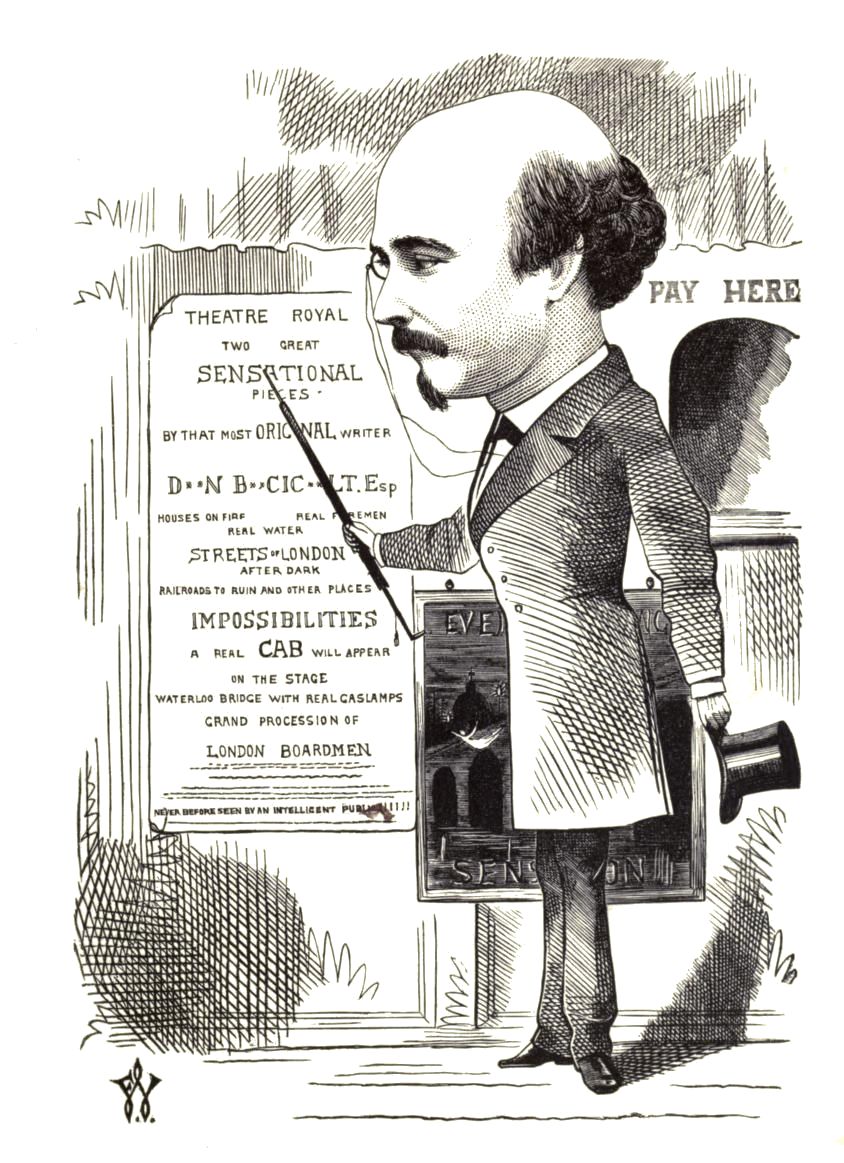
Frederick Waddy, Dion Boucicault Cartoon, Once A Week, 1873, WikimediaCommons, Public Domain
Georgia Lowe is an award-winning designer for stage and live performance. She trained with Motley Theatre Design Group and was a Linbury Prize for Stage Design finalist and resident assistant designer at the RSC. Her work spans theatre, dance, opera, indoor/outdoor events and other live performance. Lowe designed the London production of An Octoroon, directed by Ned Bennett, which opened at the Orange Tree Theatre in Richmond in 2017, later transferring to the Dorfman Stage at the National Theatre in 2018. Both theatres are intimate spaces with seating in the round, and Lowe talks here about the challenges and opportunities provided by theatre architecture and collaborative approaches to theatre design in their approaches to staging the play.
Aoife Monks: Where did you start the design process when you worked on An Octoroon? Did you engage first with the plays or with Ned Bennett the director?
Georgia Lowe: It was my third or fourth collaboration with Ned Bennett in a fairly short space of time, so it was a no-brainer for me in terms of coming on board even before reading the play. My memory of reading the BJJ An Octoroon first was ‘this is insane’ – just being really excited by the visceral, brave decisions and the fact that it left a lot for us to do. I thought this was like nothing that I’d ever read or been sent before. And doing it at the Orange Tree was also appealing – we had done a show there a year or two before called Pomona (Orange Tree Theatre, 2015), and that was quite an immersive experience, so I was excited to go back to that space with the same team to push the limits of that theatre again – or even more.
AM: Take me back to your excitement at the visceral qualities of the play. As a designer when you are reading a play what are you reacting to? Are you reading it imagining an audience watching it or are you reading it already thinking about the environment and the design approach?
GL: I never really read a play and think about what the design is going to be. I read it imagining what it’s going to be like for an audience watching it. Rather than having images of what the set design might be, I get flashes of how I would want an audience to experience it. What configuration does this play feel like it would want, or need? What would I want people to feel when they are watching it? I never really think about the design in a more straightforward sense.
With An Octoroon, when a play comes to you that feels like it’s challenging to an audience (whether that’s politically or in another way) I think it’s really exciting because it doesn’t happen that often. I’m always excited to think about how can we challenge people to think beyond what their usual experience might be – not only of this particular play, but also of their expectations of the theatre space and what performers can offer and what their relationship with a performer could be and what their relationship with the space is. And for me, An Octoroon offered all those possibilities and didn’t answer any questions when I first read it, which mean that as a team, including the performers, we had to collectively make this thing instead of me going off to my studio and designing and then someone else working out what the lighting was – it was very much a collective approach.
AM: Sticking with those initial impressions, when you have flashes of what you want an audience to feel or experience, how did you want the audience to feel at An Octoroon?
GL: One thing that Ned and I talked a lot about was spectacle and melodrama which was obviously rooted in Boucicault’s time. In our previous projects we had already been exploring how we could create narratives with props and costumes which could create spectacle but not only be decorative – we had thought about the journeys that every single thing onstage could go on. So, I think we were struck by the scenic possibilities with An Octoroon. Like Dora being on roller skates in a massive dress, or the actor playing Pete literally clambering everywhere in the Orange Tree auditorium.
Our process for working on the show was totally different than for other things I’d worked on. When I turned up on day one for rehearsals for An Octoroon, all I brought was a model box that reproduced in as realistic detail as possible the stage and auditorium of the Orange Tree theatre, with nothing else in it. So, I made all of the purple seats, I made the wooden floor and basically there was nothing else in the space – it was just a model of an empty theatre. And then we created the design through rehearsals. I was there full time. We had certain things that we knew: that we wanted to take the floor up and we wanted to use water and fire and we had ideas for the big props that we wanted. But we didn’t want to conform to the usual process of going ‘here’s the design’, where somebody spends all the money before the rehearsals have even started on building the set, before we even knew if it was right. The Orange Tree were amazing in their trust of us and they had to hold their nerve a lot because we created it as it happened.
AM: Did you actively add to the model box as those decisions got made during the rehearsal process?
GL: Yes. We showed it to actors on day one and explained some of the big ideas we had, like the floor coming up, but every couple of days we would have a meeting around the model box and we would talk about what we’d learned that day and add to it. It was fairly scary at times, but it was also really invigorating to just be able to create and know that you’ve got a (tiny) budget available for these ideas to be made possible. But the play would stand up in a black box with nothing in it – and I guess that gave us the courage to do what we did, because when you’ve got an extraordinary play that would stand up on its own anyway, you can afford to be a bit more free with the design.
AM: It sounds like you were collaborating with the play?
GL: I think we were, yeah definitely. Because it’s quite a beast of a thing, the play, it’s complicated and it takes a lot of talking and thinking and a lot of it has to be treated incredibly sensitively and it meant there were a lot of difficult conversations.
AM: Why bring the elements of fire and water to the play – why did the play ask for that?
GL: There’s something about the way the play begins – with two men who end up screaming at each other and then you go back in time where here’s so much passion and anger, love and hatred. It felt instinctual to try to visually explore those using elements like fire and water.
AM: Having seen the show at both the Orange Tree and the Dorfman at the National I wanted to ask you about working in the round. I was very struck at both venues of the sense of confronting other audience members through this incredibly difficult material. The night I saw it at the Orange Tree there was a huge group of young people sitting in the balcony who were laughing really loudly at lots of the things that the older white audience members were looking very disapprovingly at. There was something fascinating about confronting different responses to the show that were going on simultaneously and it like it was part of the design – that you were really having to negotiate being in the room with other people watching this thing.
GL: Like you say, the Orange Tree is in the round and at the beginning having the lights fully on meant that the audience members in the front row felt quite exposed. It meant you were watching other people’s reactions to your reactions. That was even stronger at the Dorfman where there were more people.
AM: I was also going to ask you about make-up because Branden Jacobs Jenkins writes the politics of make-up very explicitly into the play, where only the men wear ‘faces’ onstage. Obviously, minstrelsy has a visual tradition of blackface for you to draw on but you also had to design red face and white face. Did you have discussions about the design of the make-up, or did it feel like you knew what that would be? Were there variations? Did you try different approaches out?
GL: When working with Ned there are always discussions – you have to think about what the three or four other options could be first before making a decision. What we ended up with was the actors putting the make up on themselves but we thought about loads of other ideas like – are there buckets with coloured paint in them where the actors just put their faces in it, or could we use powder, or do they apply make-up to each other? We did a lot of trials and had some make up people who came in for a few hours with a load of different tones of red, white and black make up and we tried a load of approaches. The simplest idea that was written in the play was the thing that we ended up going with.
AM: I remember that the make-up started to wear off as the actors sweated and it began to melt. Was that a deliberate thing?
GL: There was something about the journey of the play where, by the end of the show everything is falling away, which matches with the journey of the make-up. We didn’t attempt to hide that the actor has sweated so much you could see the drip marks down the make-up and there are smears – this all added to the sense of chaos towards the end of the play, before the final scene. I think that’s why the play works so well in the round because there’s this sense of being immersed in it as an audience.
AM: You mentioned there were ongoing conversations around the difficulty of this material. How difficult did the actors find blacking up which has such terrible racial violence attached to it historically?
GL: There was an incredibly supportive environment from the beginning, an open safe space for actors to have those difficult conversations. I think one of the hardest things for the actors was that they were performing to largely white audiences. The fact that it was in the round made that even harder – they were confronted more by it, and so were the people of colour in the audience.
AM: I was interested in the question of historical accuracy and how much you were playing with period detail.
GL: I get a bit bored by being really historically accurate – that just isn’t my forte. So, I do the research, but I then let it fall away – I don’t make myself stay true to the period. We were also on a shoestring budget at the Orange Tree, so we hired a lot of the costumes based on what would fit the actors and was as close to the period as possible. And then we added an extra-large crinoline for Dora’s skirt and loads of trim to her dress– and those details were partly historical and partly rooted more in melodrama, trying to make the costumes much bigger. We did our best with what we had, while at the National we were able to be more vivid and make bolder decisions about the costumes when they were made from scratch.
I didn’t do any designs at all for any of the costumes at the Orange Tree, it was very similar to how we designed the set – working with the actors as we were going, I would chat to them every few days about images of costumes – and they brought in images too and did some of the work as well. They might do a Pinterest board of any images that they feel relate to their character – it’s so helpful to get their input from the beginning because you’re then giving the actors more ownership of their costume.
AM: One of the most beautiful objects onstage was the rabbit head – it was very realist. Given you were working within melodrama you could have chosen something folksy or homemade – why did you end up making such a detailed head?
GL: We were really torn between something that felt more horror-like, like in the film Donny Darko, or we also thought about taking a home-made approach. I did all sorts of mood boards for Ned. What we ended up deciding was that it needed to be amazing and spectacular. It needed to be totally different to the rest of the piece. We had staged the rabbit’s appearance more often than was stated in the text – the rabbit danced at the end of Act One for example. We wanted the rabbit head to be this striking thing that took people aback.
We couldn’t find anyone to make it because we’d left it so last minute – we went to a props-making workshop and they said: ‘we can’t possibly make it in the time you want, but we have made a bunny head for an advert years before and we have the moulds for it and we could use the mould for it.’ And it was almost identical to the shape of what we wanted and then we designed how it looked. And then it was quite a lot of work to get it comfortable on the performer Cassie’s head. She put up with a lot of discomfort to make it work, even though she loved wearing it. She could tell the energy of the theatre when she came on as the rabbit – it all changed. She loved doing it, but it was quite a thing to wear.
AM: My last question is about taking the floor up and staging the photograph which is the climax of the play. You say you knew you wanted to take the floor up – was this a way to work out what more you could do with the Orange Tree, or were you trying to say ‘this is how we could do melodrama given what we’ve got’.
GL: It was the spectacle thing, asking how, in this quite limited space, that doesn’t have flying or a sub-stage and doesn’t have the usual technologies to deliver spectacle, how could we best do it? We knew the floor came up because we had lowered the floor slightly for Pamona. I’m always really excited by how you can change space in front of an audience and we both instinctively felt that there needed to be a change of space for the slave auction. Taking up the floor then gives you all these other opportunities like filling it with water, or setting it on fire, or creating an island in the middle that becomes narratively a different space. It was a means to create spectacle in front of the audience’s eyes and really change the architecture.
We were staunchly attached to the actors moving the floor but when we went to the National we had to renegotiate that. So, the crew of the Dorfman came on and took the floor away – and that was a hugely memorable moment of the show for lots of people. That became a performance in itself – it was fascinating to watch. When I asked him what he’d thought of the show, my Dad said ‘I really liked the bit when they took the floor up.’ I loved that this was the bit that he remembered.
Aoife Monks is Professor of Cultural and Creative Industries and Director of the Centre for Creative Collaboration at Queen Mary University of London. Her research focuses on costume and backstage work at the theatre, as well as engaging with histories of virtuosity, entrepreneurialism and Irishness during the Celtic Tiger economy in Ireland. She is the PI (with Nicholas Daly) of the AHRC funded research network Boucicault 2020: Circuits of Skill – which this special issue is one outcome.
