
Affects
Short essays by Eltis, McNulty and Schweitzer on the sensations provoked by Boucicault’s melodrama, and Jacobs-Jenkins’ investigation of their legacies and politics.
- Sensational Octoroons – Sos Eltis
- The / An Octoroon and ‘The Law’ – Eugene McNulty
- Child Death in The/An Octoroon; or, the grievability of Paul’s murder – Marlis Schweitzer
Sensational Octoroons
Sos Eltis
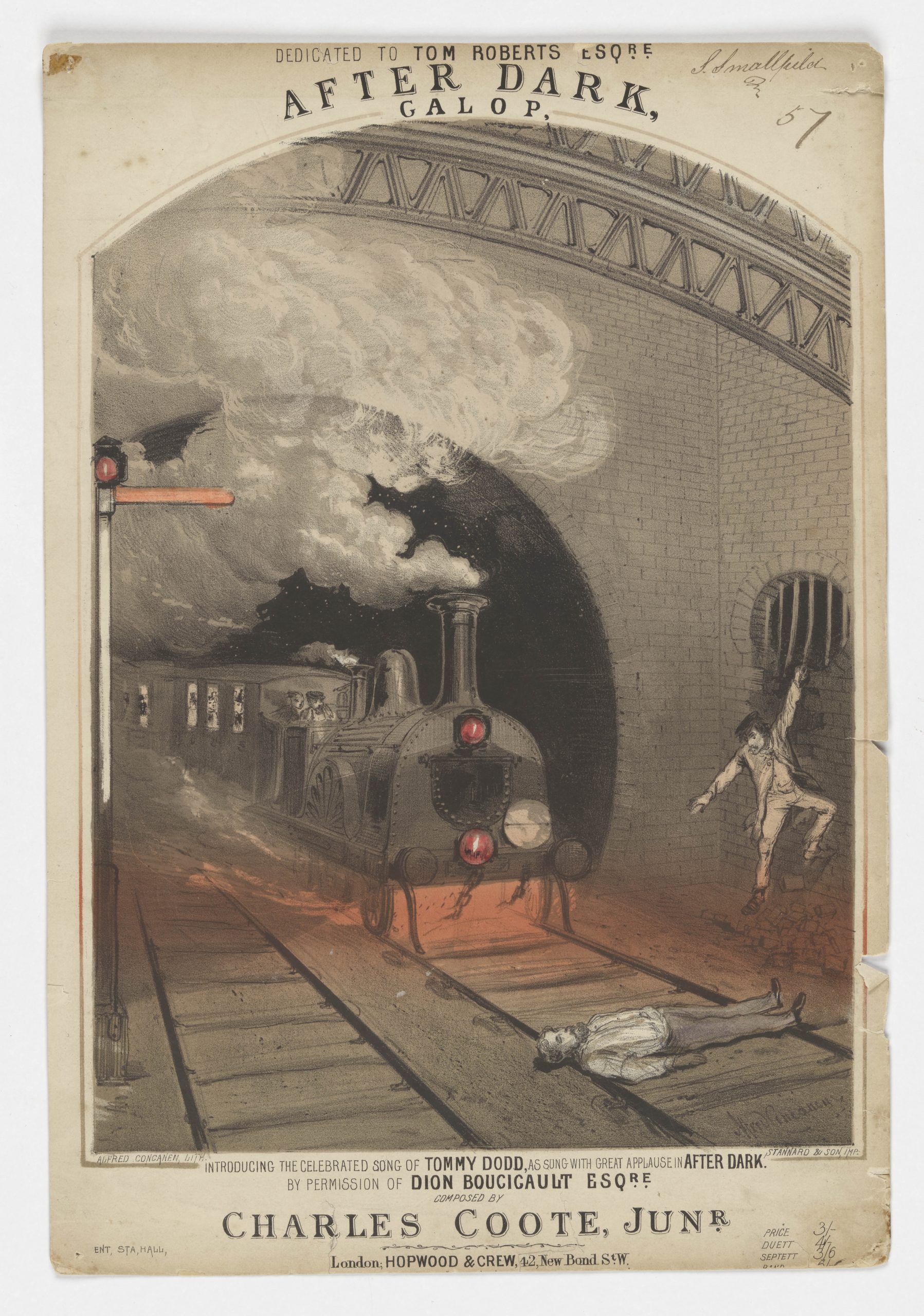
Boucicault collection, University of Kent
The sensation scene, as the two playwrights (avatars for the author and Dion Boucicault) explain in Jacobs-Jenkins’s An Octoroon, is when all the resources of the stage are pushed to their limits ‘to overwhelm your audience’s senses to the end of building the truest illusion of reality’, simultaneously engulfing the audience ‘with fake destruction’ and delivering the moral of the play.1 Boucicault’s Act IV sensation scene has Wahnotee nearly lynched when M’Closky whips up racial hatred against him, before a photograph reveals M’Closky’s guilt and he is arrested, only for him to escape by setting fire to the paddle-steamer, closing the act with a spectacular explosion. Faced with re-creating this extravaganza on the tiny in-the-round stage of Richmond’s Orange Tree Theatre at the English premiere of An Octoroon in 2017, BJJ mournfully declared, ‘I think I fucked up.’ His disturbingly confrontational solution is to wheel on an OHP and project the grainy photograph of a real-life lynching. As Richmond’s predominantly white audience stared at the white crowd gathered to view the murdered victims of racial violence, Jacobs-Jenkins visceral sensation scene simultaneously reproduced and critiqued the moral implications of its source play. Justice is a contested term in Boucicault’s original scene. The photograph of M’Closky committing murder is greeted as a gift from ‘the eye of the Eternal’, as the ‘real American hearts’ of the gathered slave owners are declared to be all that is needed to identify ‘freedom, truth, and right’ and deliver speedy executions ‘where necessity is law.’2 This ‘justice’ is explicitly white. The grandfather of the murdered black boy and Wahnotee, the native American falsely accused of the crime, are brushed aside: ‘T’aint you he has injured, ’tis the white man, whose laws he has offended’, declares Scudder, the plantation manager.
Boucicault’s auction scene similarly combines vivid feeling with unsettling implications. Zoe is put up for sale, transformed from human being to property by the financial mechanism of debt and recovery. Played in both New York and London by Boucicault’s Scottish wife Agnes Robertson, Zoe’s blackness was conjured by the audience’s imagination, the supposedly indelible marks of her racial difference patently fictional. An equally unstable performance of race was offered by the sale of Pete moments earlier. Instructing his fellow slaves to hide their distress for the sake of their owners’ finer feelings, Pete attempts to prove his vitality and raise his price by dancing on the auction block – a reproduction of minstrel entertainment which in turn reproduced the dances of slaves forced to prove their liveliness and docility to raise their value.3
The Octoroon’s climax was the death of Zoe. Having internalized the role of tragic mulatta, she takes poison from the hand of her unwitting lover in despair at her own ‘poisoned’ blood.4 At the Adelphi Theatre in London in 1861, as Zoe died, a panel in the house then slid back to the accompaniment of plaintive music to reveal ‘a “sensation” tableau, showing a Red Indian with a scalping-knife in his hand, and at his feet the prostrate body of a man whom he has just slain’ on the grave of the murdered Paul – a spectacle of the savage ‘justice’ of lynch-law in the ‘wilds of the West’.5 Hissed by English audiences, this conclusion was condemned by critics as unearned tragedy in an unchallenging melodrama; Zoe’s death was deemed ‘gratuitous and unnecessary’, a mere accident of timing.6 Boucicault doubled down. Writing to the Editor of the Times, he insisted that his play addressed ‘features in slavery far more objectionable than any of those hitherto held up to human execration, by the side of which physical suffering appears as a vulgar detail.’ Zoe’s death, Boucicault declared, resulted from ‘the horrors of her position, irremediable from the very nature of the institution of slavery.’7 Setting aside Boucicault’s claim that all Southern slaves were well treated by their masters, his conception of the most objectionable features of slavery logically implied not only the sexual subjection inflicted on female slaves like Zoe (and her mother and grandmother), but also the dehumanization and internalized racism exemplified by Zoe and Pete. For the ills of slavery to be irremediable, Zoe must view herself as inherently unfit for George’s love, even in a country where their marriage is legal.
English audiences hissed the play’s ending, outraged by what they judged to be the unnecessary suicide of the beautiful octoroon girl. Boucicault held out for nearly three weeks, then gave in and wrote a new ending, from which he carefully distanced himself, announcing it ‘composed by the public, and edited by the author.’8 In a neatly readjusted moral schema, M’Closky stole Zoe and held her captive, until she was rescued in a dramatic shootout in which the villain plunged to his death, George and Zoe were united and vowed to fulfil their love in a land of freedom, and an injured Scudder won the love of the plantation heiress Dora. Heroism and justice were neatly aligned, and the dehumanizing effects of slavery dissolved. This was not, however, a compromise that Boucicault was happy to accept. The published version of The Octoroon reinscribed the original’s unstable moral implications. This version closes with a spectacular sensation in which the paddle-steamer explodes as George arrives with Zoe in his arms, leaving the play’s romantic possibilities ambiguously open. Moments before, Scudder threatened to deliver M’Closky to the ‘tomahawk of the savage’ as punishment for the Yankee overseer’s failure to show the ‘protection and forbearance’ that alone justify the white man’s claim to racial superiority over ‘the red man and the black man.’9 Pete alone speaks for Christian mercy. When the villain sets light to the steamer and makes his escape, a ruthless fight to the death results, ‘ending with the triumph of WAHNOTEE, who drags M’CLOSKY along the ground, takes up the knife and stabs him repeatedly.’10 Violence, affect, and visceral impact are combined to sensational effect, but there is no moral clarity to this sensational ending: lynch justice renders white supremacy and ‘savagery’ indistinguishable. The exploding steamer provides a spectacular finale, while perhaps hinting at the violence inherent in a society riven by slavery and the destruction that lay ahead.
The ending of Jacobs-Jenkins’s An Octoroon comically deflates Zoe’s tragic heroics, viewing them through the bemused and sceptical eyes of Minnie and Dido. ‘If Zoe’s lightskinned ass wanna call you old and go poison herself over some white man, then you need to let her do that and move on’, Minnie advises, reducing the Octoroon’s dilemma to the perverse priorities of internalized colourism.11 Rejecting the role of dehumanized property and prop in a drama of self-regarding white folk, Minnie insists on their centrality to their own lives: ‘I know we slaves and evurthang, but you are not your job’ (as Jacobs-Jenkins defiantly notes at the friends’ first entrance, ‘I’m just going to say this right now so we can get it over with: I don’t know what a real slave sounded like. And neither do you.’)12 Deliberately anticlimactic, the women’s conversation is a wryly humorous and quietly heartbreaking reminder of slavery’s ordinariness, the unremitting endurance of life subject to the whims of fate and their white owners, whether on a boat or a plantation. Jacobs-Jenkins’s unsetting final image is the surreal figure of Br’er Rabbit, confronting the audience, a gavel in one hand and a tomahawk in the other – the unstable symbols of justice and brutality. An Octoroon simultaneously shifts the focus and crystalizes the tensions of Boucicault’s sensational drama.
Sos Eltis is Professor of English and Theatre Studies at the University of Oxford. She is the author of Revising Wilde: Society and Subversion in the Plays of Oscar Wilde (1996) and Acts of Desire: Women and Sex on Stage, 1800–1930 (2013), and an edition of George Bernard Shaw’s early plays. She has published numerous articles on Victorian, modern and contemporary drama, and is co-editing a new Routledge Companion to Women’s Suffrage Writing.
Back to top
The / An Octoroon and ‘The Law’
Eugene McNulty
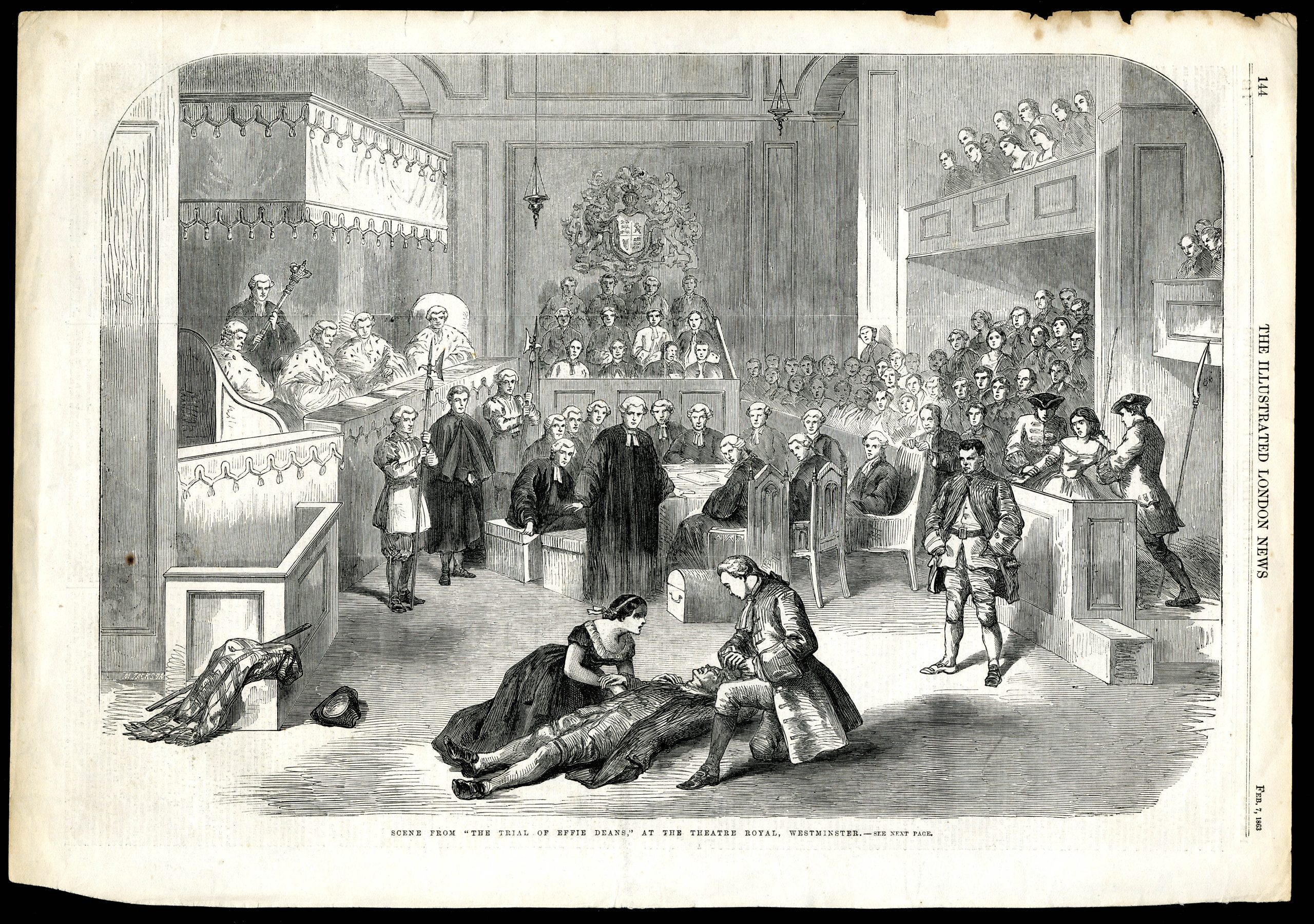
Fawkes Boucicault collection, University of Kent
Jean-Paul Sartre understood performance as the connective tissue that helps bind the literary and legal imaginations together. If ‘the law is theatre’, he proposed, then the stage might equally be imagined as ‘a courtroom in which the case is tried’.13 A century earlier, Dion Boucicault, no stranger to the inside of a courthouse, had understood something similar.14 Performed through the excessive modalities of the melodramatic, The Octoroon (1859) is a deceptively complex piece concerned with basic law and its capacity to shape human experience.15 It is haunted by an horrific legal question: is Zoe possessed of full human personhood or is she property? The name of Boucicault’s heroine is interesting in this regard – its etymological route in ‘life’ points modern-day readers to Giorgio Agamben’s work on biopolitics and the term ‘zoē’: that condition of ‘bare life’ in which a person is abandoned by the law and left to exist as a non-person.16 If ‘slave law relied on fictions of invisible taint and property rights in human beings’, then to be enslaved is to be rendered as bare life.17 While not couched in quite these terms, Boucicault would have been all too aware of the legal convulsions around this very issue that were then propelling the United States towards bellicose schism. His time in 1850s New York, for example, coincided with the case of Lemmon v. New York,18 which unfolded amidst much public interest from 1852 to 1860. The case involved a group of enslaved people brought through New York by their Virginia ‘owners’. Aided by abolitionists, the group came before the New York courts ‘seeking, legally, to become people – to change their status under law from objects into human beings’.19 As Albert M. Rosenblatt further notes: ‘The case was part of the broader judicial landscape at the time: If a law was morally repugnant but enshrined in the Constitution, what was the duty of the judge? Should there be, as some people advocated, a “higher law?” A “natural law” that transcends the written law? Issues of law and morality abounded.’20 These are issues that found their way, sometimes directly, at others more obliquely, into the legal imagination of The Octoroon. In this regard, as Gary Richardson frames it, the play’s importance largely stems from its ‘examination of a fundamental America precept – the viability of law as the framework of a democratic society.’21
As a master of the form, indeed, Boucicault knew well that this nexus of law and morality was one perfectly suited to melodramatic treatment.22 His real genius, in this regard, was his capacity to perform the kind of ideological double-voicing that saturates The Octoroon and which allows the play’s legal imagination to take on the roles of defence and prosecution simultaneously.23 A clear example of this at work can be found in the ‘trial scene’ that follows the revelation that M’Closky (and not Wahnotee) had killed the young enslaved boy Paul (a revelation that turns on one of the first uses on stage of a photograph as evidence of a crime). Throughout this scene Boucicault brilliantly balances the ideological energies flowing through the action on stage. The lynch-mob’s instincts for revenge are unleashed only to be tamed by a search for the best mechanisms to assure natural justice – a taming that usefully positions the mob’s white members as saviour figures acting on behalf of the powerless enslaved and first nation characters. In the end, moreover, it is Scudder’s voice of rationality that emerges as ascendent in its declaration of a nation built on a ‘higher power’ that requires legal process. That idea of a legal double-voicing is to be found too in the play’s major absent presence – ‘The Judge’ – one of those ‘pure psychic signs’ that Peter Brooks argues are fundamental to the melodramatic imagination.24 The Judge’s actions, inactions, and ineptitudes, incapsulate the play’s capacity to appeal to the wide spectrum of ideological views contained within its original audiences. On the one hand, Boucicault’s Judge presents us with a patrician law resting on an ethics of care in relation to those it has enslaved, while simultaneously embodying a law that is at best inept, and at worst brutishly abject, in its abandonment of key bodies within its purview. This duality is even more openly performed in the play’s auction scene. Here we see Zoe left exposed as bare life before the law – an object that can be sold to the highest bidder – a figure about whom the villainous M’Closky can declare: ‘I’ll own that Octoroon.’25 All the while, however, the pure horror of the situation is skilfully ameliorated and contained by Boucicault through the carefully sympathetic presentation of a white plantation community that competes to rescue Zoe from her intolerable position. These are a people, the scene strongly suggests, whose culture of genial good manners is based on a common decency. Mrs Peyton declares of those enslaved people who work her plantation: ‘Heaven has denied me children; so all the strings of my heart have grown around and amongst them.’26 In such moments Boucicault invites his audience to view this community of slave-owners as oppressed by a system – it is in the institutional fabric of slavery that fault lies, the play suggests, not in the actual people who benefit from it.
This tricksy performative double-voicing is further captured by an aspect of the play’s denouement: the delayed letter from the bank which simultaneously wipes out the Peyton’s debts and allows families at risk of being sold and split up to stay together. Legal process ‘saves the day.’ But the entire edifice of slavery is also revealed as structurally reliant on a nexus of the law and capital that renders certain bodies as reified entries in a ledger, as objects to be moved around in a nightmarish system of exchange. Branden Jacobs-Jenkins’s refusal to allow the letter to fully arrive in An Octoroon (2014) (‘Wait – The was a letter that was supposed to save the plantation?’) provides a key to understanding the legal unconscious of his revisioning: the law is not allowed to save the day, remaining instead as the ghostly trace that haunts the stage.27 In place of Boucicault’s performative insistence on an ideological balancing act, in its refusal to allow the key document to arrive, Jacobs-Jenkins’s version foregrounds the asymmetry of power that was the actual historical reality for the bodies on stage. In so doing, Jacobs-Jenkins’s An Octoroon locates Boucicault’s The Octoroon as a ghostly parallel text in very specific ways, inviting us to focus our attention on what Boucicault did not say and to hear the suppressed voices in those very gaps and silences. Indeed, the ghostly traumas of slave law are traced in that subtle change of title. The legalistic shift from the definite to indefinite article reminds his audiences that Zoe’s story is not singular (an idea which allows the law off the hook a little perhaps) but rather one that was terrifyingly common. In place of Boucicault’s emotionally ameliorative specificity, in other words, Jacobs-Jenkins insists that his audiences confront a common history that still lurks in the dak spaces of legal modernity.
Eugene McNulty is a Professor in the School of English, Dublin City University, where his work concerns Irish literary and theatre history. His current research projects focus on the intersections between the Irish literary and legal imaginations. These interests find resonances in two ongoing projects: the history of ‘Antigone in / and Ireland’, and a tracing of the Gothic turn in legal studies and its working through in Irish Gothic writing. He is the author of The Ulster Literary Theatre and the co-editor of a number of collections, including: Crime Culture: figuring crime in fiction and film (2010), Hearing Heaney (2015), and Patrick Pearse and the Theatre (2016); Law and Literature: the Irish Case (2022).
Back to top
Child Death in The/An Octoroon; or, the grievability of Paul’s murder
Marlis Schweitzer
Paul’s murder is the plot engine that drives The Octoroon to its explosive ending. Yet Boucicault equates Black death with children in the opening moments of the play. When the curtains rise, Grace is sitting at a table with a group of enslaved children eating breakfast. We learn nothing about these children – their names, ages, genders, hopes, dreams, aspirations. Their purpose, it seems, is to guide the audience into the world of the Terrebonne plantation. When commanded to ‘git out,’ they flee the scene but not before tripping up the character of Solon who drops a tray filled with bananas and rolls. The children gleefully grab the food before ‘Ole Uncle’ Pete, an elderly enslaved man, chases them away, yelling that he’ll ‘murder this yer crowd’ for their thievery.28 When George Peyton, the ostensible white hero of the play, enters and asks Pete why he’s so upset, the old man grumbles about the ‘black trash’ that threatens to overwhelm the plantation and promises to ‘kill some of ‘em, sure!’ He goes on to deny that the children are human, insisting that ‘dem black tings never was born at all; dey swarmed one mornin’ on a sassafras tree in the swamp.’29 Just as Topsy in Uncle Tom’s Cabin claims that she ‘never was born,’30 so too the enslaved children of Terrebonne are denied knowledge of their birth or parentage.
Pete’s words find an eerie echo in Judith Butler’s writing about grievable lives. ‘Without grievability,’ they write, ‘there is no life, or, rather, there is something living that is other than life […] Grievability precedes and makes possible the apprehension of the living being as living, exposed to non-life from the start.’31 If, as Pete insists, the children of Terrebonne are not born but rather exist as subhuman swarm, their life is ‘sustained by no regard, no testimony, and ungrieved when lost.’32 It is not only precarious: it is not human and may not even be life.
Whose lives are grievable in The Octoroon? Well, Zoe’s, of course. Why else would London audiences insist that Boucicault rewrite the ending to allow the tragic heroine to live? But let’s talk about Paul, the enslaved boy who is brutally murdered in Act 2. Unlike the other children of Terrebonne who are expected to work in the fields, thirteen-year-old Paul is permitted to do as he wishes and to roam (relatively) freely about the region with his Indigenous friend Wahnotee. When the planter Sunnyside comments that, ‘It’s a shame to allow that young cub to run over the swamps and woods, hunting and fishing his life away instead of hoeing cane,’ Mrs. Peyton explains that the boy was ‘a favourite of the Judge,’ the now-deceased owner of Terrebonne, ‘who encouraged him in his gambols.’ Given her husband’s affection for Paul, Mrs. Peyton cannot ‘bear to see him put to work.’33 This explanation, coming so soon after Pete’s reference to the absent parentage of the other enslaved Terrebonne children, sparks questions. Who is Paul’s father? What made the Judge so fond of him such that he declared that the boy was free to ‘do much as he likes’?34 Boucicault hints at an answer by describing Paul as a ‘yellow boy,’ a term used throughout the nineteenth century to describe ‘the light or golden skin tone of mixed-race slaves.’35 Yet what Paul’s status as a ‘yellow boy’ might suggest about the nature of his relationship with the Judge (or, for that matter, the other white characters in the play) is never discussed, nor is his relationship to Zoe, the other mixed race character, whose identity as an ‘octoroon’ gives the play its title. In later scenes Paul is identified as a quadroon (or one-quarter Black)36 yet the similarities between Zoe and Paul, their light skin, and their kind treatment by the Judge, implies that they may have more in common than Mrs. Peyton thinks. Why, then, doesn’t Boucicault say more about Paul’s parentage or go further to highlight the obvious connection to Zoe? The answer boils down to a question of grievability.
Paul dies while posing for a photograph with Scudder’s camera. Coming onto the scene, M’Closky at first thinks the boy is sleeping and notices that he is sitting on the mailbag containing the promissory letter that will allow Mrs. Peyton to avoid selling Terrebonne. Desperate to force her hand and secure the plantation for himself, M’Closky acts quickly. Seizing the tomahawk left behind by Wahnotee, he strikes Paul dead, grabs the documents, and runs away. Everything else in the play erupts from M’Closky’s cold-blooded murder: the famous auction scene, the threat to Wahnotee, Zoe’s suicide, the steamboat explosion. If not for Paul’s death, The Octoroon would have no tension, no suffering, no suspense, no melodrama.
Yet for all this, Paul’s death is rarely discussed by scholars writing on either Boucicault’s The Octoroon or Branden Jacobs-Jenkins’s An Octoroon. When commentary exists it is often no more than a plot synopsis or brief character sketch.37 This scholarly response to the death of a Black child mirrors the response of the white characters in the play, who take no time to grieve the boy but rather debate his worth as a slave and then turn accusing eyes on Wahnotee. No matter that Wahnotee was Paul’s closest (only?) friend or had just brought word to Pete and others that the boy was dead. No. Wahnotee’s Indigeneity is all that is needed to confirm his guilt in the eyes of the white community who threaten him with lynching.
What makes Paul’s death so puzzling – if not outright infuriating – is that it serves a dramaturgical function not unlike the intensely grieved death of Little Eva in Uncle Tom’s Cabin. Indeed, one wonders whether Boucicault, writing in the shadow of Harriet Beecher Stowe’s monster smash, meant to invite comparisons between the two characters. In life, Paul is carefree, playful, inquisitive, and eager to help others. His relationship with Wahnotee doubles Little Eva’s relationship with Uncle Tom in that both children assume the role of teacher with their older friend and express concern for their health – physical (in Wahnotee’s case) and spiritual (in Uncle Tom’s). Paul is especially concerned about Wahnotee’s alcoholism and strives to help the man avoid the temptation to drink. Like Little Eva, he is naïve yet curious about the world: an innocent keen to learn more. Both young characters share an interest in photography; and both have experienced previous brushes with death – Little Eva when she fell off the river boat, only to be rescued by Uncle Tom; and Paul when he was ill and near death while Wahnotee sat vigil.
Yet the children’s deaths, when they do come, are radically different. The angelic Little Eva dies in bed at the end of Act 3, surrounded by weeping family members, servants, and enslaved men and women. Her death forms a poignant tableau of white innocence and heavenly reward – one that produced a powerful affective charge in audiences around the world, reducing them to sobbing messes.38 By contrast, Paul dies alone – bludgeoned by a weapon associated with his dear friend. The horrific tableau that coheres around Paul’s death blurs Blackness, violence, and the absence of innocence. No weeping chorus or family members surround the thirteen-year-old boy. Although, in most versions of Boucicault’s play, Paul’s death is invoked in a final tableau, with Wahnotee standing near his grave after he has sought out and killed M’Closky,39 the message is clear. Even a favored ‘yellow boy’ like Paul is expendable; indeed, his status as a boy points to a critical difference between his innocence and Little Eva’s. On the cusp of puberty, Paul is not yet a man nor is he one of the ‘swarm’ underfoot, but the closer he gets to adulthood, the more his freedom to roam about Terrebonne destabilizes racial hierarchies Paul is not yet a threat, but he soon will be. Within the dramaturgical logic of the play, he must die for the plot to advance. His death cannot be grieved – it must remain ungrievable – because to invite audience sympathy for Paul is to risk directing attention and emotion away from Zoe. It is also to invite sympathy for a boy who is almost a Black man.40
In An Octoroon, Branden Jacobs-Jenkins asks his audience to think differently about Paul’s death, which he achieves by reworking the dramaturgical techniques of Boucicault’s play to serve his purposes.41 First, in his notes on casting, Jacobs-Jenkins pairs the characters of Pete and Paul with the figure of the Assistant. In so doing, he presents two stereotypes of enslaved Black masculinity in one body:42 the internalized racism of the old man Pete rubs against the naïve innocence of Paul, alongside the Assistant figure who aids the Playwright in realizing his vision. In the ‘Dramatis Personae’ for the play, Jacobs-Jenkins insists that the role should be ‘played by a Native American actor, a mixed-race actor, a South Asian actor, or an actor who can pass as Native American.’43 Tellingly, by insisting that Paul should not to be played by a Black actor, Jacobs-Jenkins purposefully calls into question the equation of Blackness, masculinity, and death. These casting directions also forcefully reject the nineteenth-century practice of casting an adolescent white girl to play Paul in breeches and blackface; blackface serves a different purpose in Jacobs-Jenkins’ world.44 Intriguingly, the Abbey Theatre’s 2022 production of An Octoroon nodded to the role’s original casting when it cast the Indian American actor Jolly Abraham as the Assistant/ Pete/ Paul, further disrupting stereotypes of Black masculinity and South Asian femininity.45
Second, Jacobs-Jenkins spotlights the violence of Paul’s death with a stage direction that calls for ‘a large pool of blood’ to flow from the boy’s wounds and ‘gather around Paul’s head and M’Closky’s feet.’46 By making explicit the violence and gore of Paul’s death, Jacobs-Jenkins implies that the character is not an empty vessel, not a two-dimensional character type, nor the product of some spontaneous swarm. He is a vulnerable, fully formed human. His blood stains the stage and the shoes of his killer. Thus, evidence of his death remains in sight for the rest of the play.
Third, Jacobs-Jenkins confronts his audience with their complicity in anti-Black and anti-Indigenous racism with a stunning photographic reveal. Grimly flipping the Boucicauldian ‘sensation scene’ on its head, Jacobs-Jenkins situates Paul’s death within a much longer history of Black death at the hands of white men (and women). The enlarged photograph of a public lynching that hangs over the stage as George argues for Wahnotee’s innocence compels the audience to witness Black (and other forms of racialized) death in a way that Boucicault’s staging of Paul’s death does not.47 Jacobs-Jenkins implicates the (white) audience in the scene – and in centuries murdering Black and Indigenous men, women, and children – just as the photograph of M’Closky standing over Paul’s body with a tomahawk implicates him in the boy’s death. The sensation scene calls on the audience to feel – to be horrified – to weep, perhaps. Unlike Boucicault, Jacobs-Jenkins insists on the horror and the grievability of Paul’s death. His play demonstrates how, in Butler’s words, ‘we each have the power to destroy and be destroyed… we are bound to one another in this power and this precariousness. In this sense, we are all precarious lives.’48
Marlis Schweitzer is Professor of Theatre and Performance Studies at York University in Toronto, Canada. She is the author and editor of several books, including When Broadway Was the Runway: Theatre, Fashion and American Culture (2009) and Bloody Tyrants and Little Pickles: Stage Roles of Anglo-American Girls in the Nineteenth Century (2020), recipient of the George Freedley Memorial Award from the Theatre Library Association. Marlis is past editor of Theatre Research in Canada and Theatre Survey, a former President of the Canadian Association for Theatre Research, and the current Chair of the Department of Theatre, Dance, and Performance at York University.
Back to top

Notes:
- Branden Jacobs-Jenkins, An Octoroon (London: Nick Hern Books, 2014), p.64. ↩
- Dion Boucicault, The Octoroon in Selected Plays of Dion Boucicault, edited by Andrew Parkin (Gerrards Cross: Colin Smythe, 1987), p.173. ↩
- Joseph R. Roach, ‘Slave Spectacles and Tragic Octoroons: A Genealogy of Antebellum Performance’, Theatre Survey 33:2, 167-87: (pp.173-4). ↩
- Boucicault, The Octoroon, 153. ↩
- Standard, 19 November 1861; Boucicault, The Octoroon, p.173. ↩
- Morning Post, 20 November 1861. ↩
- Cork Examiner, 23 November 1861 ↩
- Morning Chronicle, 11 Dec 1861. ↩
- Boucicault, The Octoroon, pp.188-89. ↩
- Boucicault, The Octoroon, p.190. ↩
- Jacobs-Jenkins, An Octoroon, pp.76-7. ↩
- Jacobs-Jenkins, An Octoroon, p.77, p.22. ↩
- Jean-Paul Sartre, Sartre on Theatre (London: Quartet Books, 1976), p.127. ↩
- For more on Boucicault’s chequered legal career as a serial plagiarist, and the prominent role that he would eventually play in the development of modern copyright law (in the United States particularly) see: Sarah Meer, ‘Adaptation, Originality and Law: Dion Boucicault and Charles Reade’, Nineteenth Century Theatre and Film 42, No. 1 (2015), 22–38. ↩
- For more see: Gary A. Richardson, ‘Boucicault’s The Octoroon and American Law’, Theatre Journal 34, No. 2 (1982), 155-164; Stephanie J. Pocock, ‘The Judicial and the Melodramatic Stage: Trial Scenes in Boucicault’s Arrah-na-Pogue and The Octoroon’, Theatre Journal 60, No.4 (2008), 545-561. ↩
- For more see: Giorgio Agamben, Homo Sacer: Sovereign Power and Bare life (Trans. Daniel Heller-Roazen) (Stanford, Cal.: Stanford University Press, 1998). ↩
- Colin Dayan, The Law is a White Dog: How Legal Rituals Make and Unmake Persons (Princeton: Princeton University Press, 2011), p.12. ↩
- More popularly known as the Lemmon Slave Case. ↩
- Albert M. Rosenblatt, The Eight: The Lemmon Case and the Fight for Freedom (Albany: State University of New York Press, 2023), xiv. ↩
- Albert M. Rosenblatt, The Eight: The Lemmon Case and the Fight for Freedom, xv. ↩
- Gary A. Richardson, ‘Boucicault’s The Octoroon and American Law’, Theatre Journal 34, No. 2 (1982), 155-164, (p.155). ↩
- For more see Peter Brooks, The Melodramatic Imagination: Balzac, Henry James, Melodrama, and the mode of excess (New Haven: Yale University Press, 1996). ↩
- For a broader discussion of Boucicault’s ‘double-voicing’ see Eugene McNulty, ‘Moral Legibility: Dion Boucicault and the melodramatic legal scene’, Adam Hanna and Eugene McNulty (eds), Law and Literature: The Irish Case (Liverpool: Liverpool University Press, 2022), pp.245-257. ↩
- Peter Brooks, The Melodramatic Imagination, p.36. ↩
- Dion Boucicault, The Octoroon, Selected Plays: Dion Boucicault (Gerrards Cross, Colin Smythe Ltd., 1987), pp.135-190, 149 [my italics]. ↩
- Dion Boucicault, The Octoroon, p.160. ↩
- Branden Jacobs-Jenkins, An Octoroon (London: Nick Hern Books, 2018), p.77. ↩
- See Dion Boucicault, The Octoroon: a play in four Acts (New York: The De Witt Publishing House, c. 1861). Archive.org, https://archive.org/details/octoroonplayinfo00bouciala/mode/2up. See also The Octoroon; or, life in Louisiana: a play, in five acts (New York: Printed, not published, 1861). ↩
- Boucicault, The Octoroon; or, life in Louisiana, p.3. ↩
- Harriet Beecher Stowe, “Chapter 20: Topsy,” Uncle Tom’s Cabin or Life among the Lowly (Project Gutenberg, 1995), https://www.gutenberg.org/files/203/203-h/203-h.htm#chap20 ↩
- Judith Butler, ‘Precariousness and Grievability: When is life grievable?’ Verso Blog, 16 November 2015, https://www.versobooks.com/en-ca/blogs/news/2339-judith-butler-precariousness-and-grievability ↩
- Butler, ‘Precariousness and Grievability.’ ↩
- Boucicault, The Octoroon, a play in four acts, p.3 ↩
- Boucicault, The Octoroon, a play in four acts, i. ↩
- Dion Boucicault, The Octoroon: The Broadview Anthology of British Literature Edition (Peterborough, ON: Broadview Press, 2014), p.21. ↩
- Ibid, p.21. ↩
- See, for example, Adam Sonstegard, ‘Performing Remediation: The Minstrel, The Camera, The Octoroon,’ English Faculty Publications, 16 (2006): https://engagedscholarship.csuohio.edu/cleng_facpub/16; Jane Kathleen Curry, “Spectacle and Sensation in The Octoroon/An Octoroon,” Nineteenth Century Theatre and Film 46.1 (2019): 38-58; Verna A. Foster, ‘Meta-Melodrama: Branden Jacobs-Jenkins Appropriates Dion Boucicault’s The Octoroon,’ Modern Drama 59.3 (2016): 285-305. ↩
- On responses to Little Eva’s death, see Robin Bernstein, Racial Innocence: Performing American Childhood from Slavery to Civil Rights (New York: NYU Press, 2011); Anna Mae Duane, Suffering Childhood in Early America: Violence, Race, and the Making of the Child Victim (Athens, GA: University of Georgia Press, 2010). ↩
- See, for example, Boucicault, The Octoroon, a play in four acts, 18; Boucicault, The Octoroon; or, life in Louisiana, p.40. ↩
- It is worth noting that with the exception of Solon and the aged, and therefore sexually unthreatening, Pete, there are no Black men in An Octoroon. Thanks to Nicholas Daly for this observation. ↩
- See also Curry, “Spectacle and Sensation”; Foster, “Meta-Melodrama.” ↩
- Sam Volosky, ““I’s Not So Wicked as I Use to Was:’ The Interlay of Race and Dignity in Nineteenth-Century American Drama and Blackface Minstrelsy,” Honors thesis, La Salle University (2018), pp.21-22. ↩
- Branden Jacobs-Jenkins, Appropriate/ An Octoroon: Plays (New York: Theatre Communications Group, 2018), p.69. ↩
- Josie Orton originated the role of Paul at the Boston Museum in 1861; Miss O. Marshall played Paul at the Howard Atheneum the same year. Boucicault, The Octoroon; or life in Louisiana, p.2. ↩
- Abbey Theatre, ‘An Octoroon,’ https://www.abbeytheatre.ie/whats-on/an-octoroon/. Thanks to Aoife Monks for calling my attention to this production. ↩
- Jacobs-Jenkins, An Octoroon, p.91. ↩
- Jacobs-Jenkins, An Octoroon, p.103. ↩
- Butler, ‘Precariousness and Grievability.’ ↩