
Reception and Afterlives
Short essays by Riordan, Chen and Lonergan investigating the endings and afterlives of The/An Octoroon.
- The Endings in the Octoroon Plays – Kevin Riordan
- The Abbey Theatre’s An Octoroon (2022) and The Irish Times Theatre Awards 2023 – Chaomei Chen
- Re-connections – Patrick Lonergan
The Endings in the Octoroon Plays
Kevin Riordan
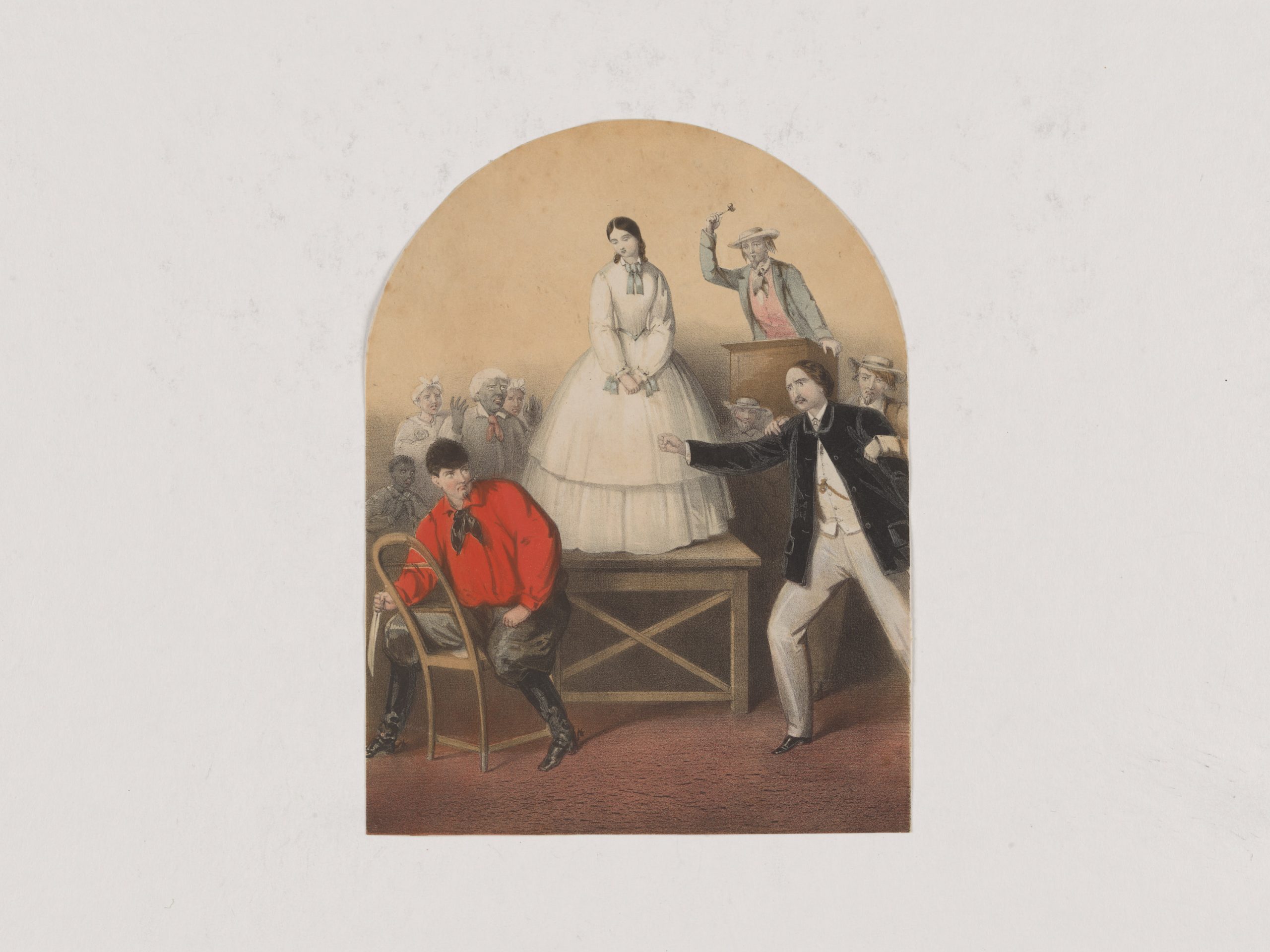
Image courtesy of the Dion Boucicault Collections, Special Collections and Archives at the University of Kent.
Dion Boucicault’s The Octoroon always had multiple endings. Famously, there were two early variations. In the 1859 New York production Zoe dies after swallowing poison, but she would survive at the end of the British version from 1861. When Boucicault updated his own closing scenes—to rectify the play’s message, to placate popular tastes, or simply to sell more tickets—he deferred credit. The new play was ‘composed by the public and edited by the author.’1 While the British public’s ending seems to imply greater social tolerance towards the play’s interracial marriage—in the States, the characters’ union was illegal—John Degen insists that the change had more to do with genre and taste than racial politics.2 Audiences simply preferred a happy ending to a tragedy. More recently, scholars have found evidence of still other endings in prompt books and reviews from the U.S., the U.K., and beyond, further complicating the story of the play’s two endings.3 But across this paper trail a clear pattern emerges: Acts One through Three remain largely the same, while the last act (or two, depending) is subject to significant revision. It is always the ending that changes.
Zoe’s variable fate has been a central concern for the play’s critical legacy, serving as shorthand for the play’s unresolved problems and its treatment of race. Yet for an individual audience member in the nineteenth century—unaware of alternate endings—this character’s personal end did not leave as strong an impression as some of the play’s other, more spectacular business. Act Four of the American version, for example, features a steamboat burning down the river. A related stage image marks the English revision’s finale: ‘noise increasing—The steam vessel blows up—grand Tableau.’4 Tableaux of this kind made for memorable attractions, and they often punctuated act endings in the period’s sensation melodramas. These signature stage pictures also circulated beyond the theater on posters, advertisements, and other ephemera. In The Octoroon’s early visual archive Zoe’s death (or her survival) was upstaged by the play’s more popular illustrated ‘sensations’: the steamboat explosion, the dramatic role of the camera, and the slave auction.
Branden Jacobs-Jenkins explores and exploits the source material’s established adaptability in his 2014 An Octoroon. He moots several staging ideas for the most sensational set pieces. Jacobs-Jenkins miniaturizes Boucicault’s boat explosion: a character enters ‘carrying a small flame or lantern’ and announces simply, ‘Then the boat explodes.’5 This indicative narration is underwhelming, if a potential punchline in performance, but the playwright offers something more surprising: ‘Cotton rains down on the audience. Or not.’ For the slave auction, the scene that most troubled Boucicault’s first audiences, Jacobs-Jenkins is again provocatively indecisive. He invites directors to adapt his own adaptation: ‘There is either one or ninety-nine people playing various bidders. Or maybe there’s some clever way to force the audience into doing this.’6 Finally, rather than produce a photograph to prove a character’s guilt, Jacobs-Jenkins rolls out an overhead projector to display something more grotesque and arresting, ‘a lynching photograph on the back wall.’7 One of the characters explains this kind of sensation melodrama to the audience, that the point is ‘to make you feel something.’8
In an often-cited interview, Jacobs-Jenkins stresses his plays’ ambition to provoke the spectator’s feelings.9 He seeks to complicate the audience’s affective engagement in a fashion reminiscent of epic theater: you feel something, and you think about feeling it. In An Octoroon, this feeling might be the deceptive lightness of cotton, the weight of participation and complicity in a slave auction, or the responsibility of bearing witness to lynching. When the silent character Br’er Rabbit peers at the audience in the inter-scenes, the audience acutely feels their own seeing being seen.10 An Octoroon disturbs and disorients, and it foists the sensations of sensation melodrama on to the audience. With the various endings in particular, Jacobs-Jenkins refuses to let Boucicault’s Octoroon stand as a safe, historical curiosity, something that can be explained away through context, distance, or genre. The live feelings surprise you. There is something—and something wrong—in the present, not just the past.
An Octoroon finally ends with a different kind of surprise: an unspectacular scene of extended dialogue. At the top of Boucicault’s Act Five, Zoe approaches Dido (a cook on the plantation, a ‘mammy’ character) for poison. Jacobs-Jenkins leaves Zoe behind and stays with Dido and another character, Minnie, for the remainder of An Octoroon. Minnie had a single line in the Boucicault script and here takes on a larger role. During the auction scene she is called ‘Minerva,’ and through their names these two ensemble characters evoke a Roman goddess and the founder of Carthage. They also provided the exposition at the start of Act One. The pair are a Greek chorus who speak the play’s first and last words.11
Our attention shifts away from Zoe and the others, further disrupting Boucicault’s emotional plot. Minnie and Dido discuss how the poison will likely kill Zoe. They shrug off complicity as well as interest: ‘These people ain’t our problem anymore.’12 Jacobs-Jenkins expresses his own fatigue with his play’s apparent responsibility to tell certain stories. His lingering with these minor tragicomic characters instead nods to the mid-century absurdism of Beckett and Stoppard, but here the conditions and consequences are more severe. Cotton balls may remain on the laps of the audience, and the afterimage of a lynching photograph haunts all that follows it on stage. Jacobs-Jenkins has us sit with the comic, irreverent ‘chorus of enslaved, visibly black women characters’ rather than revisiting once again the erotic, ‘hypnotic fascination’ of Boucicault’s ‘white-appearing octoroon.’13 Zoe’s exceptional drama was always a distraction from the more ordinary, inescapable, and cruel circumstances experienced by Black bodies. Minnie says, ‘You know I be getting so bored.’14
This too is not quite the last of the endings. Dido asks Minnie to ‘finish telling [her] about that rabbit,’ and they exit.15 The trickster figure Br’er Rabbit silently wanders in and out of this play’s tableaux, but he was never referred to this directly. He enters now, holding a tomahawk in one hand and a gavel in the other, and ‘Everyone sings’ an unspecified song. Offstage, Minnie likely tells Dido about that rabbit, but that is a story out of earshot, suggesting another extension and another adaptation of The Octoroon.
I would like to thank Chelsea Kiew for her help in developing this short essay.
Kevin Riordan is the author of Modernist Circumnavigations: Around the World in Jules Verne’s Wake (2022) and editor of Tales of an Eastern Port: The Singapore Novellas of Joseph Conrad (2023). His articles have appeared in Modernist Cultures, Theatre Survey, Public Books, and elsewhere. He is a co-founder of the Modernist Studies in Asia research network and a longstanding collaborator with the Brooklyn-based company Theater Mitu. He teaches at Temple University, Japan Campus in Kyoto.
Back to top
The Abbey Theatre’s An Octoroon (2022) and The Irish Times Theatre Awards 2023
Chaomei Chen
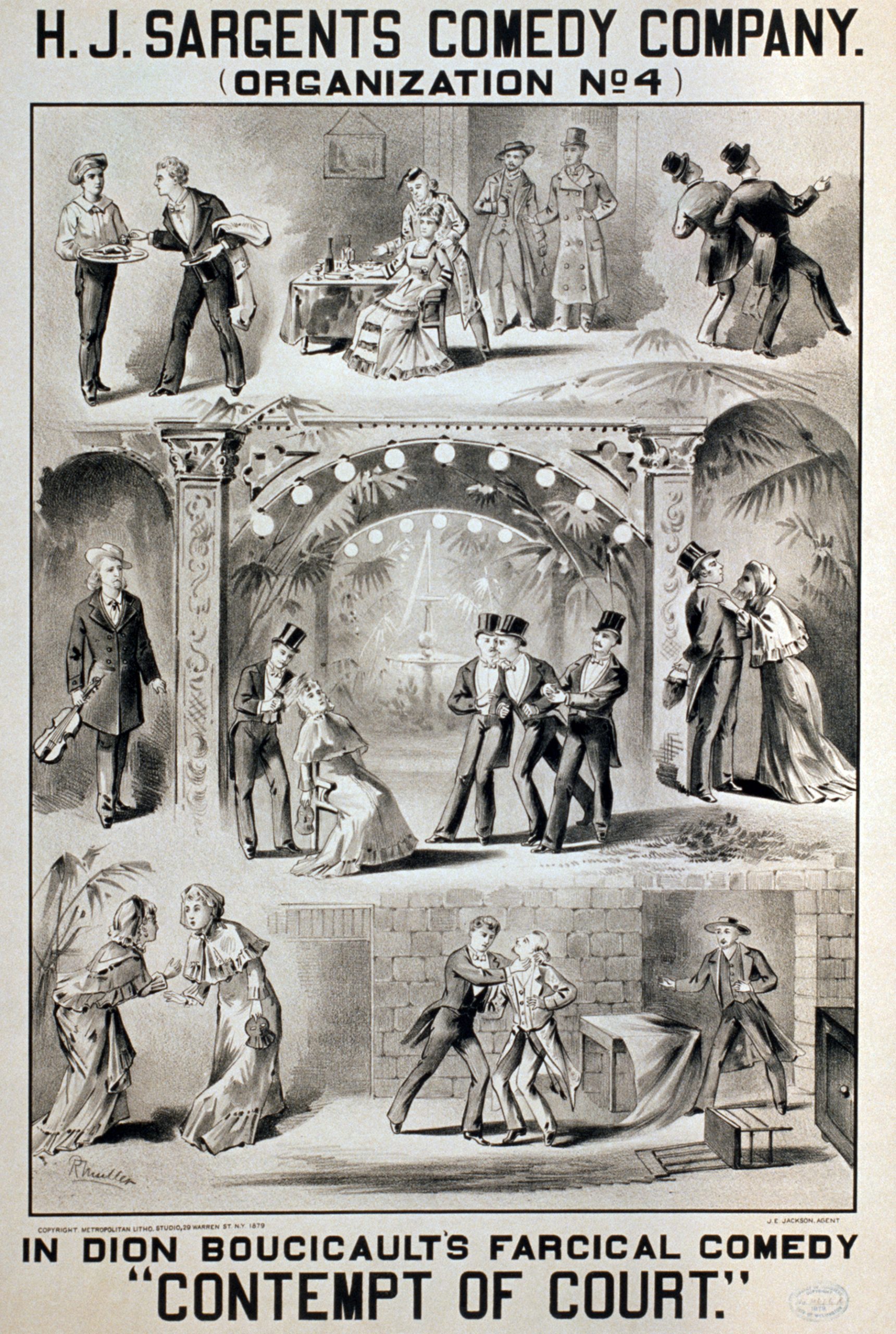
Contempt of Court, 1879, WikimediaCommons, Public Domain
An Octoroon (2022) is the Abbey Theatre’s first mainstage production by a black director from the UK, Anthony Simpson Pike, with a majority cast of people of colour (eight out of ten) such as emerging young black Irish actors Patrick Martins, Jeanne Nicole Ní Ainle, and Loré Adewusi. However, for a play that unabashedly confronts race, racism, and representation, The Irish Times Theatre Awards16 only nominated its two white cast members for Best Supporting Actor and Actress, along with a Best Production nomination in February 2023. The lack of recognition ignited the cast and creative team of An Octoroon who posted an online statement to seek support in public.
I will first map a trajectory of the controversy and responses from various parties to elucidate its social impact. On 10 February, the social media account ‘Black and Irish’ posted a statement to complain the racial imbalance in the nomination on Twitter and Instagram. As a response, the Abbey Theatre immediately tweeted that the theatre ‘is, and will continue to be, completely committed to this conversation’ through their programme and wider engagement.17 On 15 February, the Lir Academy launched its ‘Anti-Racism Policy 2023-2027’ to tackle racial issues in theatre industry. ‘As the Lir Director Loughlin Deegan said: ‘We believe that, as the National Academy of Dramatic Art, we have a responsibility to reflect the nation back at itself, in all its diversity.’18 On 20 February, The Irish Times announced that the Irish Theatre Awards would undergo a review and pause the 2023 judging process after ‘25 years of hosting the Theatre Awards.’19 On 27 February, in her article in the University Times, Hong Kong-Irish artist Choy-Ping Clarke-Ng, the assistant designer for An Octoroon, further criticized the general act of ‘tokenistic diversity hiring and casting’ in Irish theatre industry and the Irish immigration system that tended to exclude migrant artists (usually with a low-paid salary unable to meet the standards of the immigration office).20 She drew on the example of Pai Rathaya, a Thai designer, to demonstrate that it was unimaginably difficult for an immigrant artist to even stay in this country, despite all her excellence and awards in her profession and an online petition with thousands of signatures supporting her visa application. From this perspective, the lack of recognition and representation in the Theatre Awards became an expression of broader racial problems in Irish society.
Walter Benjamin’s concept of Jeztzeit denotes the now-time which both disrupts the progress of history and bridges the past and present together. It is a time that disrupts the ‘homogenous, empty time’ of history and ‘[blasts] out of the continuum of history’,21 a time ripe with energies to leap into the future. I argue that theatre as a public space also functions as such a Jeztzeit, a ‘brake’ against the actual progress of history and reality, especially considering that the judging panel itself was paused and reviewed for the first time in a 25-year history. When reality becomes more real and dramatic than theatre itself, the theatrical public space can offer an opportunity to rethink and reconnect the past with the present moment. The controversy over An Octoroon’s nomination by The Irish Times functioned as such a brake to rethink imbalanced ethnic and racial representation on Irish stage and society. The event itself became a public performance on social media, such as newspapers and Twitter, that aroused a storm in Irish theatre circles.
In her Artistic Director’s Note, Caitríona McLaughlin proudly announces that An Octoroon is one of the first plays for her first year’s programme which represents a changed Ireland with ‘a new wave of Irish peoples with mixed heritage and a multiplicity of lived experiences’ in the last 25 years. The national theatre is dedicated to ‘embrace uncomfortable past mistakes, to demonstrate [its] appetite for different perspectives, new voices and a new generation of artists’, by bring them ‘together to mark a cultural shift in the Irish artistic landscape.’ McLaughlin regards Jacobs-Jenkin’s play as ‘a contemporary take on a flawed-classic’ of Dion Boucicault who ‘was born on Gardiner St. just around the corner from the Abbey.’22 However, the , and that of Ireland more generally, have been dismissed in the mainstream narrative of Irish theatre and society, as director Simpson-Pike and scholar Patrick Lonergan have pointed out.23 In his ‘Director’s Note’, Simpson-Pike argues, that ‘this play is part of Irish history as well as American history’, because historically Irish people in America also shared this heritage of minstrelsy and Irish migrants playing minstrelsy even became a ‘prominent’ phenomenon in Boucicault’s time.24 Minstrelsy was once used as ‘a tool some Irish migrants in America used to become white’, because by ‘performing a grotesque version of blackness at least mark [Irish migrants] as not that.’25 The numerous five-star reviews in Irish newspapers and social media also tended to emphasize the accomplishment of the Abbey Theatre and condemn American racism while ignoring Ireland’s own history of racism.
Echoing McLaughlin’s announcement to ‘mark a cultural shift in the Irish artistic landscape’, the controversy over the production’s nomination takes a step forward to trigger wider public discussions. Responses to the controversy had also produced certain potential reforms in the Irish theatre industry, as we can see in The Lir Academy’s It also became a rare yet critical opportunity to force the Irish theatre industry to review and reevaluate its own perceptions and judging standards. The subsequent discussions produced a wider public debate that contributed to a further understanding of race in an increasingly intercultural Irish society. To echo Lonergan again, during the performance of An Octoroon, the huge ‘mirror’ held up to the audiences on the Abbey stage, not only invited the Abbey audience but also urged the Abbey Theatre, theatre-makers and scholars together, to see their own history of racism in Irish theatre and society.
Dr. Chaomei Chen is a lecturer at the Department of English, Soochow University in China. She obtained her doctoral degree in Drama at Trinity College Dublin in 2025. Her research interests include contemporary Chinese theatre, leftist theatre, liyuanxi, and contemporary Irish theatre. She was the winner of the New Scholars Prize at the International Federation for Theatre Research (IFTR) Conference 2023. Her most recent publication is “Restaging Lao She’s Socialist Cosmopolitanism: Intercultural Dramaturgy in Meng Jinghui’s Teahouse (Chaguan) (2018-19)” (The Drama Review, forthcoming). Her publications have also appeared in Theatre Research International, Performance Research, Theatre Journal, etc.
Back to top
Re-connections
Patrick Lonergan
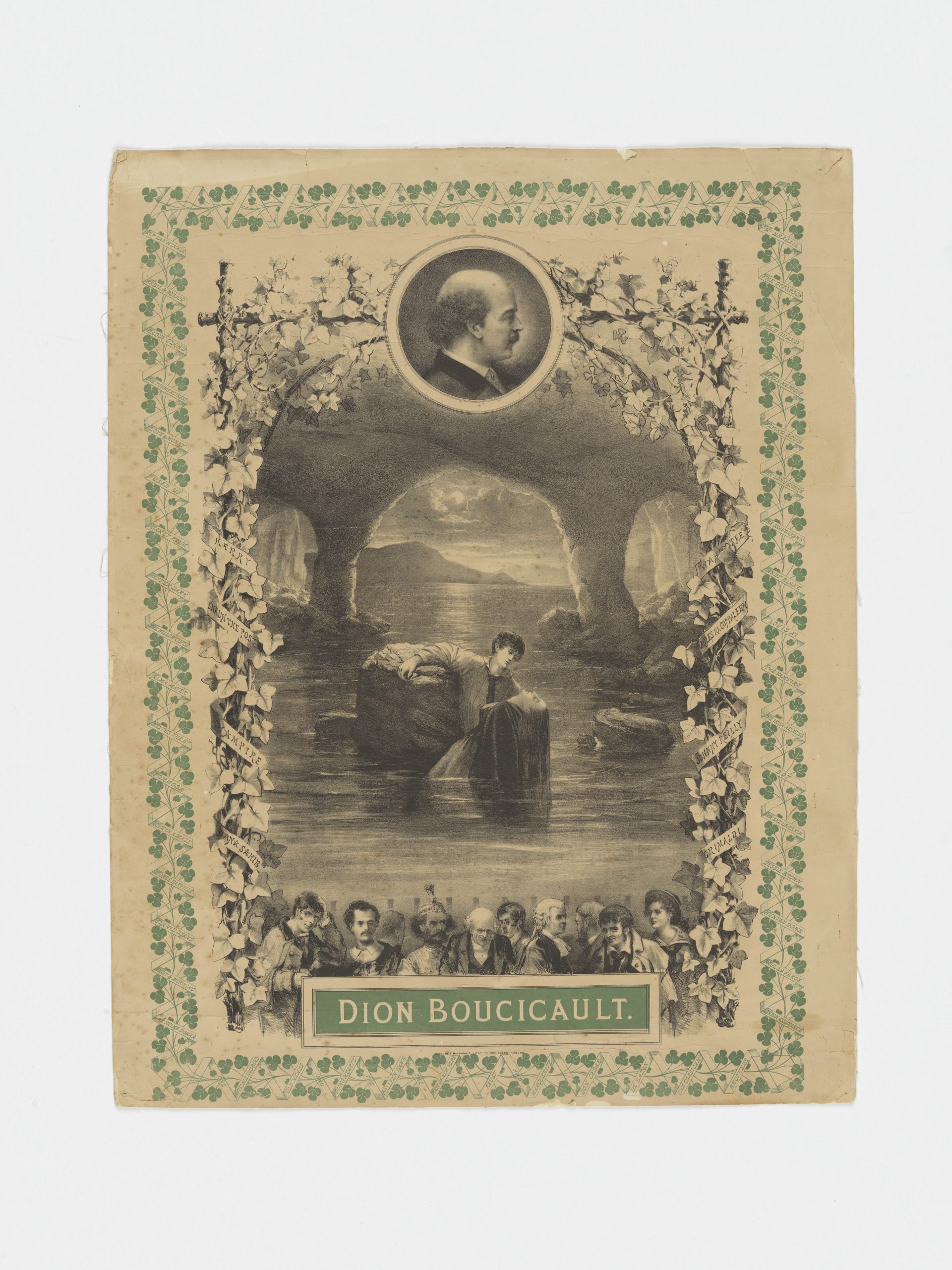
Boucicault collection, University of Kent
The production of Branden Jacobs-Jenkins’ An Octoroon at the Abbey Theatre in 2022 marks a key moment in the recent history of the Irish stage. In the words of the theatre’s Artistic Director Caitríona McLaughlin, it was programmed to ‘mark a cultural shift in the Irish artistic landscape’, not only by casting an unprecedentedly diverse group of young actors, but also by engaging in new ways with the international repertoire.26 It was also historical in the sense that it invited Irish audiences to think about the past in new ways. Although his work was hated by the Abbey co-founders WB Yeats and Lady Gregory, Boucicault is now regularly revived at the theatre: The Colleen Bawn (1998 and 1999) and The Shaughraun (in 2004 and 2005) are among the theatre’s most successful productions of recent decades, and a 2010 Arrah-na-Pogue was also well received. When in the first scene of An Octoroon BJJ speaks of how he was inspired to write his adaptation because his therapist advised him to ‘re-connect with things you feel or have felt positive feelings for’,27 a Dublin audience might have nodded in recognition: Boucicault is a writer that many of them would have developed ‘positive feelings for’ over many years of theatre-going. In an Irish context, Jacobs-Jenkins’ achievement is to take that familiarity and to historicise it, showing audiences how Boucicault’s treatment of Irishness intersects with his treatment of Black and native American identities.
There has been a tendency in Irish theatre history to overlook The Octoroon, partly because its American setting means that the play is judged to be irrelevant in an Irish context. As I’ve discussed in more detail elsewhere, however, it is possible that The Octoroon was at least partly inspired by an Irish play.28 At the start of his acting career, when he was still going by the stage-name Lee Moreton, Dion Boucicault played a comical Irish servant called Murtagh Delaney in William Macready’s The Irishman in London – or the Happy African (1792).29 In that play, the character later played by Boucicault declares his love for the eponymous happy African, a woman named Cubba who was almost certainly performed in blackface by a white actor. ‘I wish she was not sooty,’ Delaney complains, before adding that ‘I believe she may be the daughter of a king, for she has the mind of a prince – If her face was but as white as her heart, she’d be a wife for a pope.’30
Was Boucicault thinking of Macready’s play when he wrote The Octoroon? There are definite resemblances between the two works: both can be criticised for treating racism and slavery with levity, but both are also of interest for proposing that romantic love can allow for the setting aside of the prejudices and stereotypes that were believed true by many within the characters’ societies.
But rather than wondering if Boucicault is guilty of (yet another case of) plagiarism, perhaps it might be of more value to see both plays in the context of their history on the Irish stage, to ask why that history has been almost completely forgotten, and to consider what it might mean to retrieve it.
In its juxtaposition of Irish and African characters, Macready’s play was drawing a parallel between Irishness and blackness that would frequently be made, especially in the United States, during the nineteenth century.31
Yet An Irishman in London was also immensely popular in Ireland itself. It was first performed at the Theatre Royal in Dublin in 1792, just a few months after its London premiere – and it would continue to be performed in Dublin and Belfast at least once a year until 1830. Performances became less frequent thereafter, with the last recorded staging of the play in Ireland occurring shortly after the Great Famine of 1845-1850, probably because Irish audiences’ attitudes to race and slavery were increasingly being informed, in both positive and negative ways, by visiting American minstrel groups and by the influence of a growing number of abolitionist dramas, including several adaptations of Uncle Tom’s Cabin. Thus, when The Octoroon was performed in Ireland (and it was staged there relatively often from the 1860s to 1960s), it was doing so before audiences whose attitudes to race and racism had been shaped by a performance tradition that stretched back to the eighteenth century, and which certainly intersects with the history of stage Irish performances during the same period.32
What might it mean to retrieve that tradition? In May 2024, the Irish Baroque Orchestra offered a possible answer to that question when they released a recording called Rachel Baptist: Ireland’s Black Syren.33 Baptist was an Irish soprano of African descent, who performed regularly and with acclaim in Dublin and London between roughly 1750 and 1775. We have no record of what she performed during that time – so the orchestra’s musical director Peter Whelan instead chose a programme of songs that she might have sung, including work by Handel and Purcell, with the songs being performed by the Scottish soprano Rachel Redmond. Whelan imagines what is likely rather than restricting himself to what is certainly known – and in doing so, he provides a model for how Irish stage histories can be retrieved. We might not know much about Baptist, but we know enough to justify the release of a recording in her name.
Perhaps this approach might offer a model for a similar kind of imaginative enrichment of Irish theatre histories and practices. We know that plays like The Happy Irishman and The Octoroon were performed in Ireland; we know that many people of colour (Black Irish, African, and African-American) performed on the Irish stage in the eighteenth and nineteenth centuries; and we also know that there is a long tradition of plays that connect Irishness and blackness together as a way of commenting upon slavery and racism (in both positive and negative ways).34 At the Abbey, for example, in 2024, McLaughlin built on her promise of using An Octoroon to mark a cultural shift by reviving Elizabeth Kuti’s The Sugar Wife (2005), a play that connects the overlapping histories of the Irish famine with the Atlantic slave trade and colonialism.35 It is essential that such plays as The Sugar Wife are produced in the present – but it is also essential that contemporary audiences are aware that artists like Kuti were asking important questions about race and Irishness more than two decades ago.
Like Jacobs-Jenkins himself, audiences and artists in Ireland have an opportunity to reconnect with the past, leaning into any ambivalence, discomfort and anger that might be felt as they do so. The lack of information in the archives is a barrier – but we certainly have enough to work with. Such a history might allow us to dig into the possible connections between artists like Baptist, Macready and Boucicault, deepening our understanding of all – but it would also allow new possibilities to emerge, for both performance and scholarship.
Patrick Lonergan is the Professor of Drama and Theatre Studies at University of Galway, in Ireland. He is the author of many books on Irish theatre and literature, including most recently Theatre Revivals for the Anthropocene (2023) and Druid Theatre: Fifty Years (2025). He is a member of the Royal Irish Academy, an Executive Committee member of the International Federation for Theatre Research, and Chair of the Board of Directors of Galway International Arts Festival.
Back to top

Notes:
- The Times, qtd. in John A. Degen, ‘How to End “The Octoroon,”’ Educational Theatre Journal 27, no. 3 (May 1975): p.172. ↩
- Ibid., p.174. ↩
- Lisa Merrill and Theresa Saxon, ‘Replaying and Rediscovering The Octoroon,’ Theatre Journal 69, no. 2 (June 2017). ↩
- Dion Boucicault, ‘The Octoroon,’ in The Wadsworth Anthology of Drama, Fourth Edition, ed. William Worthen (Boston: Wadsworth, 2005), p.986. This anthology includes both the 1859 and the 1861 endings. ↩
- Branden Jacobs-Jenkins, Appropriate / An Octoroon (New York: Theater Communications Group, 2019) p.210. ↩
- Ibid., p.193. ↩
- Ibid., p.206. ↩
- Ibid., p.211. ↩
- Eliza Bent, ‘Branden Jacobs-Jenkins: Feel that Thought,’ American Theatre, May/June 2014, https://www.americantheatre.org/2014/05/15/brandenjacobsjenkins_appropriate_octoroon-2/ [accessed 21 August 2024]. ↩
- Bomi Jeon, ‘Seeing Race in Post-Racial America: Spectatorship and Visibility of the Racial Experience in Branden Jacob-Jenkins’ An Octoroon (2014),’ The CEA Critic 84, no. 1 (2024): p.72. ↩
- Ibid., p.70. ↩
- Jacobs-Jenkins, p.217. ↩
- Merrill and Saxon, p.152; Joseph Roach, Cities of the Dead: Circum-Atlantic Performance (New York: Columbia University Press, 1996), p.215, p.220. ↩
- Jacobs-Jenkins, p.218. ↩
- Ibid. ↩
- The Irish Times Theatre Awards is one of the most important theatre awards in Ireland. ↩
- Abbey Theatre, ‘A comment on #AnOctoroon and the Irish Times Theatre Awards nominations’, Twitter, 10 February 2023. See https://x.com/AbbeyTheatre/status/1624108954081959939. Accessed 23 August 2024. ↩
- Colin Gleeson, “Lir Academy’s anti-racism policy can be ‘catalyst for change’ in dramatic arts”, The Irish Times, 15 February 2023. For more details about the “Anti-Racism Policy 2023-2027”, see https://www.thelir.ie/news/the-lir-academy-launch-an-anti-racism-policy. Accessed 20 April 2024. ↩
- Mary Carolan, ‘Irish Theatre Awards judging for 2023 paused while review of process takes place’, The Irish Times, 20 February 2023. See https://www.irishtimes.com/culture/stage/2023/02/20/irish-theatre-awards-judging-for-2023-paused-while-review-of-process-takes-place/. Accessed 20 April 2024. ↩
- Choy-Ping Clarke-Ng, ‘The Irish Theatre Awards Must Reflect the Diversity of Artists in the Industry’, The University Times, 27 February 2023. See https://universitytimes.ie/2023/02/the-irish-theatre-awards-must-reflect-the-diversity-of-artists-in-the-industry/. Accessed 27 March 2024. ↩
- Walter Benjamin, Illuminations: Essays and Reflections by Walter Benjamin (Translated by Harry Zohn, Schocken Books, 2007), p. 261. ↩
- An Octoroon Programme, Abbey Theatre, 2022. ↩
- Both Abbey and the Irish stage in general practiced blackface in their productions, such as The Emperor Jones (Abbey, 1927). For more details on the relationship between An Octoroon and Irish blackface/minstrelsy performance and race on the Abbey stage and the Irish stage, see Patrick Lonergan, ‘Race, Minstrelsy, and the Irish Stage: The Origins and Afterlives of Dion Boucicault’s The Octoroon’, in Race in Irish Literature and Culture, edited by Malcolm Sen and Julie McCormick Weng (Cambridge: Cambridge University Press, 2024), pp. 59–80. ↩
- The white performers of US minstrelsy included Irish migrants, who acted out a white supremacist concept of blackness which justified slavery and oppression against Black people. ↩
- ‘An Octoroon Programme’, Abbey Theatre, 2022. ↩
- Abbey Theatre, ‘An Octoroon’. Show programme. Dublin: Abbey Theatre, 2022, p. 2. ↩
- Branden Jacobs-Jenkins, An Octoroon (New York: Dramatists Play Service, 2015), p.7 ↩
- Patrick Lonergan, ‘Race, Minstrelsy, and the Irish Stage: The Origins and Afterlives of Dion Boucicault’s The Octoroon’ in Malcolm Sen and Julie McCormick Weng (eds), Race in Irish Literature and Culture (Cambridge University Press, 2024), pp. 59-80. ↩
- This information is given in a playbill from 1838 in The University of Kent Boucicault archives UKC/POS/BOUC/THE CHE R : 0648671 ↩
- William Macready, The Irishman in London – or the Happy African: A Farce (London: Longman, 1799), p. 32. ↩
- For the fullest account of that topic, see Eric Lott, Love & Theft: Blackface Minstrelsy And The American Working Class (Oxford University Press, 2013), Noel Ignatiev, How the Irish Became White (London: Routledge, 2009), David Roediger, The Wages of Whiteness. London: Verso, 2007. ↩
- I provide a fuller discussion of this stage history in ‘Race, Minstrelsy, and the Irish Stage’ ibid. ↩
- Linn Records: CKD740, May 2024. ↩
- The most detailed treatment of this theme is Charlotte McIvor’s Migration and Performance in Contemporary Ireland. London: Springer, 2016. ↩
- For a full discussion of the play and its links with The Octoroon see Patrick Lonergan, Theatre and Globalization. Basingstoke, Palgrave, 2009, pp. 206-215. ↩